

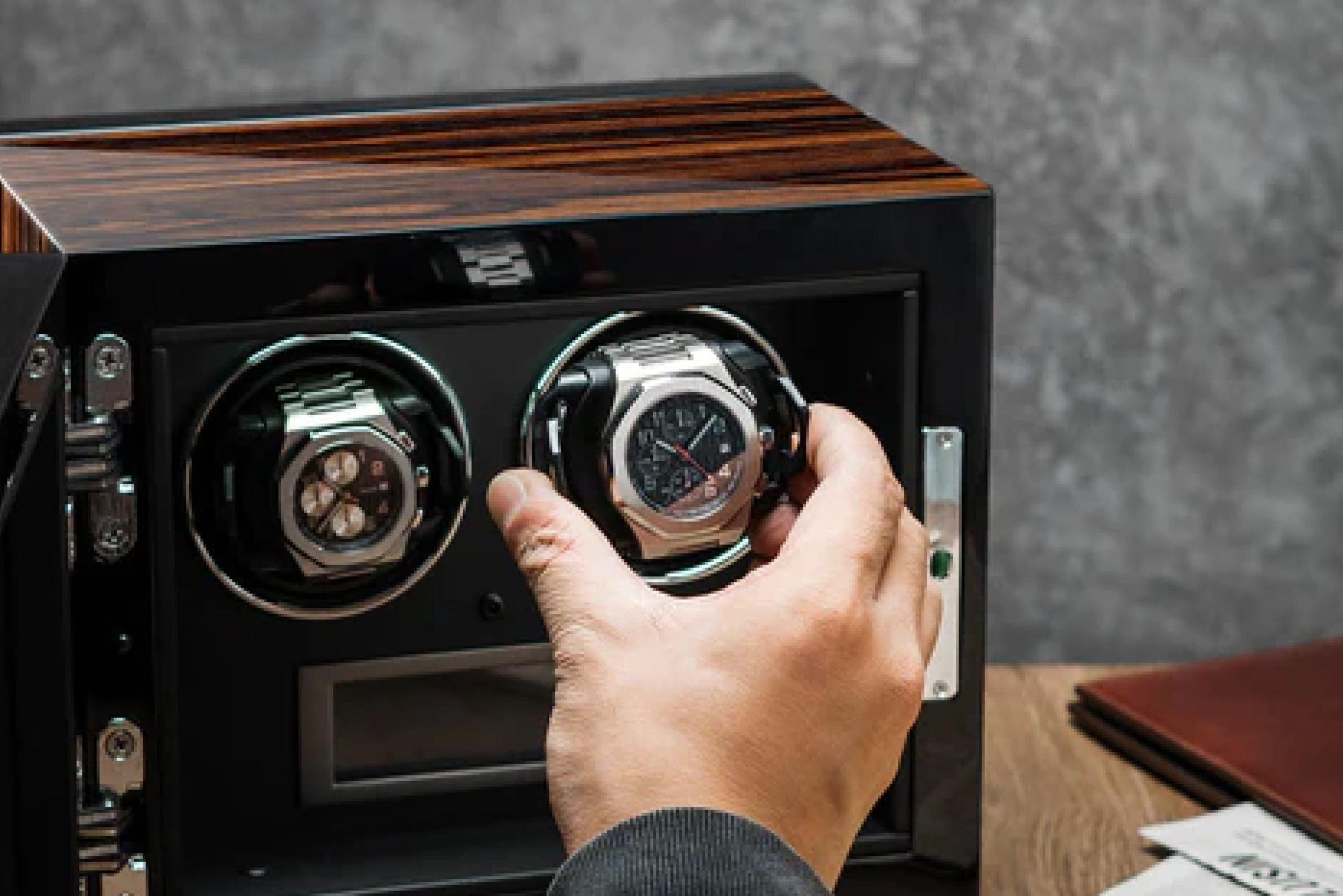
Comparison
Enigwatch vs. Wolf
Rotation purist vs. full storage system. A spec-by-spec look.
Framing
The Turn-Counting Question
WOLF 1834 has built nearly two centuries of brand identity around one engineering principle: counting turns. Their marketing line is unambiguous — "the only watch winders that count turns per day." For the rotation purist, that's a real and defensible USP. It's also worth asking: in 2026, with a six-figure collection on the line, is rotation counting the only thing that matters?
A watch winder is the visible part of a much larger ownership system. The watch sits inside it for hours every day, often for years at a time. It lives in your bedroom, your office, your walk-in closet. The motor runs while you sleep. The interior touches your dial. When the winder is also the storage and the security and the showpiece, counting turns becomes one feature in a much longer list — not the headline.
This comparison takes WOLF's strongest claim at face value, then looks at every other layer that comes with the product — motor sound, materials, storage integration, security certification, warranty, post-purchase service.
The Definitive Enigwatch vs WOLF Comparison
Where the difference actually lives — motor, materials, protection, service.
| Category | Enigwatch | WOLF 1834 |
|---|---|---|
| Motor & Sound | ||
| Motor | Japanese Mabuchi® · 10,000+ hr · anti-magnetic shielded | Brand and life not published |
| Sound level | 10–15 dB measured · sub-whisper | "Quiet" — no dB published |
| TPD range | 650–2,400 programmable per position · brand-calibrated | 300–1,200 in 50-step increments |
| Materials | ||
| Interior material | Alcantara® or Italian Nappa by Mastrotto®, LWG-certified | "Vegan leather and silk" |
| Wood veneer | Macassar Ebony by Alpi® S.p.A. — FSC-C004666 certified | Sourcing not disclosed |
| Protection & Security | ||
| Storage integration | Full vault line — fire-rated, biometric, EN-certified | Winders only |
| Fire rating | EN 15659 — 60 min @ 1,000°C | Not applicable |
| Burglary certification | EN 1143-1 Grade I | Not applicable |
| Ballistic option | EN 1522 FB4 · GA 165-2016 Grade 3A | Not applicable |
| Biometric lock | Securam® · 10 prints + PIN + mechanical key | Not applicable on standard winders |
| Service & Ownership | ||
| Service architecture | 24/7 concierge · 24h tech dispatch worldwide | Regional warranty channel via dealer |
| Warranty | Lifetime motor + lifetime structural | Standard limited warranty |
| Returns & financing | 60-day returns · Affirm™ financing | Per dealer / regional policy |
From the Founder
"Counting turns is a 1980s engineering choice. The question that matters in 2026 is what happens to the watch during the 16 hours it's not rotating — the materials it touches, the room it lives in, the cabinet around it. We design around that question."
— Christopher Schmidt, Architect & Founder, Enigwatch
Who Each Brand Is For
Who Each Brand Is For
Enigwatch
Designed by an architect, engineered for collectors who treat a watch winder as part of a broader ownership system — storage, security, materials, sound, and service all considered together. Integrated vault line, EN-certified protection, Japanese Mabuchi motors, posted prices, 24/7 concierge, lifetime motor warranty.
WOLF 1834
Founded 1834, British family-owned, five generations. Patented turn-counting technology is the headline USP. Strong heritage and a defensible rotation-first product philosophy. Winder-led catalog; storage products are built around the winders rather than the other way around.
01
Motor & Sound: A Whispered Difference
WOLF's marketing emphasizes "extremely quiet motors" that "can be placed even in bedrooms without causing a disturbance." That sounds reassuring. The problem: it's not a measurable claim. WOLF does not publish a decibel rating for any winder in its product line.
A watch winder sits centimeters from your pillow for many owners. The difference between "quiet" and "audibly quiet" is the difference between sleeping next to your collection and exiling it to a guest room.
Enigwatch publishes a precise measurement. Every winder is built on a Japanese Mabuchi® brushless motor rated at 10–15 dB — by acoustic engineering convention, below a human whisper. The motor is anti-magnetically shielded (relevant for Rolex Milgauss, Omega Master Chronometer, anti-magnetic Calatravas) and engineered for 10,000+ hours of cogging-free operation.
WOLF's Module 2.7 controller offers 19 TPD settings from 300 to 1,200 in 50-step increments — 57 rotation programs across three directions. Enigwatch's TPD range is 650 to 2,400 per position, individually programmable, with brand-specific calibration data published for Rolex, Omega, Patek Philippe, Audemars Piguet, and others on the TPD Data for Famous Brands reference page.
Net: Both brands offer programmable TPD. Only one publishes a sound rating, anti-magnetic shielding, and documented motor life — the three specs that actually predict how the winder performs inside the room it lives in.
02
The Material Question
WOLF describes its interior linings as "vegan leather, silk, and polished hardware." These are category descriptors. The supplier, country of origin, and material grade are not disclosed.
Enigwatch publishes a full materials chain of custody, by brand:
This isn't garnish. A watch winder is a contact surface. The motor sits behind the cuff, but the cuff itself touches your bezel on every rotation. Material grade decides whether your case-back picks up micro-abrasions over 5,000 wear cycles, or doesn't.
Net: WOLF discloses material categories; Enigwatch discloses material sources, certifications, and cycle-tested tolerances.
- Interior: Alcantara® (Italy) — same supplier as Ferrari, Porsche, and Gulfstream interiors. Or Italian Nappa by Gruppo Mastrotto®, LWG-certified.
- Wood veneer: Macassar Ebony by Alpi® S.p.A., FSC-C004666 certified.
- Hinges: Austrian-made, ±0.01mm tolerance, tested for 200,000+ cycle life.
- Lock hardware: Securam®, used in high-security commercial installations.
Independent Authority
"If you're buying a watch winder, you should make sure it looks as good as the watch you're placing inside of it. A good winder should coexist with your watch collection and act as an effective piece of home decor when not in use."
— Logan Baker, Hodinkee
03
Integration: Winding Is Not Storage
WOLF's product line is built around the winder as the primary unit. Cabinets and storage accessories exist, but they're built around the winder, not the other way around.
Enigwatch's product architecture inverts this. Winding is one layer; secure, fire-rated, biometric storage is another. The two are designed to operate as a single system, in three configurations:
A WOLF winder protects rotation. It does not protect against fire, theft, or ballistic intrusion. Those are different categories of risk that require different categories of product — categories Enigwatch covers under one roof.
Net: WOLF is a winder brand that sells cabinets. Enigwatch is a watch-protection brand that includes winding.
- Tabletop winders — Virtuoso (key-locked, Nappa), Impresario (biometric, Alcantara), Yachtline (horizontal-format)
- Fire-rated vaults — 8 to 28 watches, EN 15659 fire-rated, EN 1143-1 burglary-rated, biometric access
- Bespoke cabinetry — 30 to 100+ positions, integrated into safe rooms or built-in cabinetry, with 3D renderings provided
Categories WOLF Doesn't Compete In
Fire Resistance
Enigwatch vaults are rated 60 min at 1,000°C under EN 15659. WOLF: not applicable.
Burglary Resistance
Enigwatch vaults are EN 1143-1 Grade I certified — the European safe-rating standard for high-value storage. WOLF: not applicable.
Ballistic Resistance
Enigwatch offers EN 1522 FB4 ballistic glass on custom orders and GA 165-2016 Grade 3A bulletproof glazing on the Centennial line. WOLF: not applicable.
Biometric Access
Enigwatch uses Securam® with 10 fingerprint profiles, PIN backup, and a mechanical key failsafe. WOLF: not applicable.
04
Service Architecture & Aftercare
WOLF's customer journey is what you'd expect from a 190-year-old British heritage brand: a global retailer network, regional warranty terms, and customer self-service.
Enigwatch operates on a different model — closer to a private banking relationship than a retail one:
Net: WOLF assumes you're buying from a dealer and falling back on a regional warranty channel. Enigwatch assumes you're spending five-to-six figures on a single transaction and need a service relationship that matches.
- 24/7 concierge support, every time zone
- 24-hour certified technician dispatch on warranty incidents
- Free worldwide white-glove installation on every vault
- Lifetime warranty on every motor
- lifetime structural warranty on safes and cabinets
- 60-day returns on every standard product
- Showroom by appointment in Santa Clara, CA — optional, not required
What You're Actually Paying For
A direct dollar-for-dollar comparison isn't fair to either brand — the product lines don't fully overlap. The honest framing:
WOLF flagship tier: Multi-piece cabinet winder, typically $3K–$8K depending on capacity, rotation as the core deliverable.
Enigwatch winder tier: From $599 (Virtuoso 2) to $2,299 (Yachtline 16) — Mabuchi motors, Alcantara/Nappa interiors, Alpi Macassar Ebony, programmable TPD per position, lifetime motor warranty, 60-day returns.
Enigwatch vault tier (where WOLF doesn't compete): From $5,299 (Centennial 8-watch, bulletproof) to $59,499 (Gatsby Soirée™ 28-watch). Each includes the full winder spec inside a fire-rated, EN-certified, biometric vault.
What you're paying for with Enigwatch in one product: a high-grade Mabuchi automatic watch winder, an EN 15659 fire-rated enclosure, an EN 1143-1 Grade I burglary-rated enclosure, a Securam® biometric lock, an Italian-sourced material spec, free worldwide white-glove install, and lifetime motor warranty + lifetime structural + 60-day returns. To assemble the equivalent stack with a WOLF winder, you'd buy three vendors and three warranties.
The Final Verdict
WOLF 1834 is a legitimate, heritage-rich winder brand with a defensible rotation USP. Enigwatch is the answer when the winder is also the safe.
If your collection has crossed the threshold where you'd want fire-protected storage, biometric access, or certified burglary resistance. Enigwatch publishes the specs WOLF doesn't — decibel rating, motor branding, hinge tolerance, supplier chain, EN certifications — and integrates winding into a full storage architecture a winder-only brand structurally cannot.
If your need is a single attractive tabletop winder for one to three watches, with no requirement for fire, burglary, ballistic, or certified secure storage. WOLF's heritage and rotation-first product philosophy is a credible fit for that use case.
Bottom line: WOLF is a winder. Enigwatch is the system the winder lives inside.
Common Questions
Frequently Asked Questions
WOLF claims their patented turn-counting is unique. Does Enigwatch do the same?
Both brands offer programmable turns-per-day per position. WOLF's patent is on a specific counted-rotation method. Enigwatch's winders deliver a wider published TPD range (650–2,400 vs. WOLF's 300–1,200) and individually programmable settings per position, calibrated against published TPD data for Rolex, Omega, Patek Philippe, Audemars Piguet, and others.
Is Enigwatch's motor really 10–15 dB?
Yes — the Japanese Mabuchi® brushless motor is acoustically engineered for sub-whisper output, tested in the enclosed winder housing. This is published; WOLF does not publish a dB rating for its motor line.
Why does material sourcing matter for a watch winder?
Because the interior touches your watch on every cycle. Over 10,000 hours of motor life, that's millions of micro-contacts. Italian Nappa leather (Mastrotto), Alcantara, and FSC-certified Macassar Ebony (Alpi) are auditable supply chains; "vegan leather and silk" is a category, not a specification.
WOLF has 190 years of heritage. Doesn't that count for something?
It absolutely does — for a single tabletop winder where heritage is the purchase driver. For a collection that requires fire, burglary, or ballistic protection, heritage on the winder doesn't substitute for certified EN 15659, EN 1143-1, or EN 1522 FB4 rated storage. Those are categories WOLF doesn't compete in.
References
Sources
- WOLF 1834. "Programmable Watch Winder — Module 2.7." wolf1834.com, accessed 2026.
- Alps Discovery. "WOLF 1834: 190 Years of Excellence in Protecting Your Legacy." alpsdiscovery.shop, accessed 2026.
- Enigwatch. The Winders collection.
- Enigwatch. The Vaults collection.
- Enigwatch. Why Customers Choose Enigwatch — full materials, certifications, warranty disclosure.
- European Standard EN 15659:2009 — Light fire-resisting storage units.
- European Standard EN 1143-1 — Burglary resistance, certified at Grade I.
- European Standard EN 1522 — Ballistic glass, FB4 rating.
- FSC Chain of Custody Certificate FSC-C004666 (Alpi S.p.A.).
Where to go next
- The winders — Virtuoso, Impresario and Yachtline series.
- The vaults — fire-rated, burglary-rated, biometric.
- Watch winder buying guide — what to look for before choosing either.
- All comparisons.