
Panerai Luminor movements are among the least demanding automatics to wind — but get the settings wrong and you’ll either under-wind a 72-hour power reserve or stress the rotor on a movement that needs far fewer turns than most collectors assume.
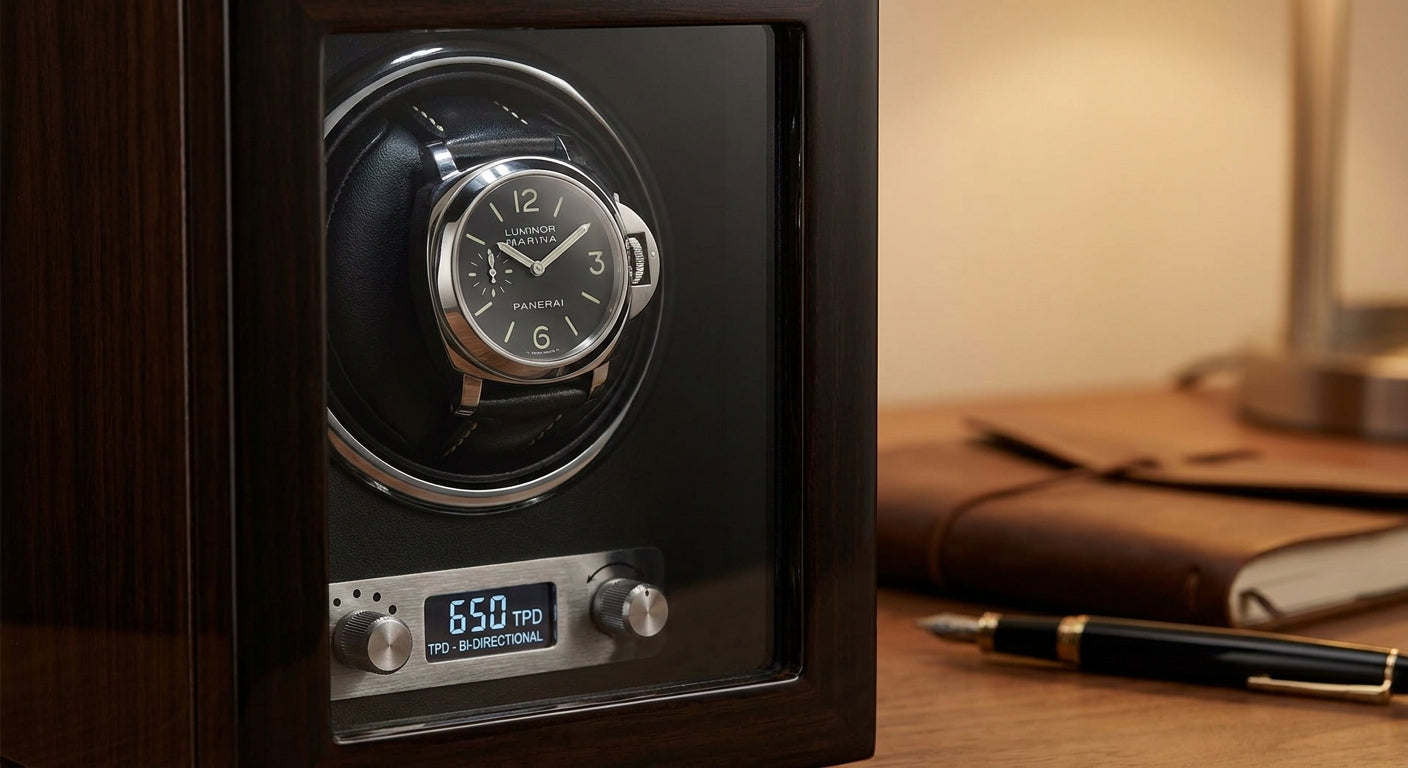
TL;DR: The correct watch winder settings for Panerai Luminor are 650–900 turns per day (TPD), bidirectional rotation, with rest intervals programmed between winding cycles. Most Luminor calibers — including the in-house P.9000 and P.9010 — reach full wind in under 800 TPD. Set your winder to bidirectional (CW+CCW) or counterclockwise-only if your unit supports it, run 900 TPD as the ceiling, and never exceed 1,200 TPD. A quality winder like those in the Enigwatch Impresario or Virtuoso series handles these settings precisely, keeping your Luminor ready without over-winding.
Why Panerai Luminor winder settings matter
Panerai’s in-house calibers use a unidirectional rotor on some models and a bidirectional rotor on others. The P.9000, introduced in 2005 and used across the core Luminor line through 2026, winds in both directions. The older ETA-based calibers (6497, 6498) wind in one direction only — typically clockwise. Misidentifying your caliber means you could run the rotor constantly against its natural winding direction, adding wear without actually charging the mainspring. That’s the problem this guide solves.
What you’ll need
- Your Panerai Luminor’s caliber number (found on the caseback or in the original documentation)
- A programmable watch winder with adjustable TPD settings in increments of 100 or finer
- Knowledge of your winder’s rotation modes: CW only, CCW only, or bidirectional (CW+CCW)
- A rest-interval feature on the winder (recommended — continuous spinning is unnecessary and adds mechanical wear)
- 5 minutes to confirm the movement is fully wound before placing it in the winder
Step 1: Identify your Luminor caliber
Pull the caseback or check the original papers. The caliber number determines everything else.
- P.9000 / P.9010 / P.9001 / P.9002 — Panerai in-house, bidirectional winding, 72-hour power reserve
- P.3000 / P.3001 — In-house, bidirectional, 72-hour reserve, slightly lower TPD demand
- ETA 6497 / 6498 — Ebauche-sourced, unidirectional (CW), 56-hour reserve
- OP XXXIII (ETA 2824-2) — Bidirectional, 38-hour reserve, found in older Luminor Base models
If you cannot identify the caliber, default to bidirectional at 650 TPD — it is the safest setting across the entire Luminor catalog and will not damage any of these movements.
Common mistake: Assuming every Luminor uses the same caliber because they share a case shape. The Luminor Base, Luminor Marina, and Luminor 1950 can all house different movements in the same production year.
Step 2: Set the correct TPD for your caliber
TPD (turns per day) is the single most important setting. Too low and the watch stops. Too high and you add unnecessary mechanical stress over months of continuous winding.
| Caliber | Recommended TPD | Direction | Power Reserve |
|---|---|---|---|
| P.9000 / P.9010 | 650–800 | Bidirectional | 72 hours |
| P.9001 / P.9002 | 700–900 | Bidirectional | 72 hours |
| P.3000 / P.3001 | 650–750 | Bidirectional | 72 hours |
| ETA 6497 / 6498 | 650–800 | CW only | 56 hours |
| ETA 2824-2 | 650–800 | Bidirectional | 38–42 hours |
Start at the lower end of the range. If the watch stops after 48 hours of non-wear, increase by 100 TPD and test again. Most Luminor owners land between 650 and 750 TPD in practice — the 72-hour reserve means the watch tolerates missed cycles far better than a 40-hour movement.
Common mistake: Setting TPD to 1,800 or higher because “more is better.” Panerai’s in-house movements are efficient winders. Anything above 1,200 TPD on a P.9000 is wasted rotation that adds rotor bearing wear without adding power reserve.
Step 3: Set the rotation direction
This step depends entirely on the caliber identified in Step 1.
- P.9000, P.9001, P.9002, P.9010, P.3000, P.3001, ETA 2824-2 — Set to bidirectional (CW+CCW). These movements wind efficiently in both directions, so bidirectional cuts the TPD needed to reach full charge.
- ETA 6497 / 6498 — Set to clockwise only (CW). These calibers have a unidirectional winding mechanism. Running them CCW spins the rotor without engaging the winding train, so the movement stays unwound.
If your winder does not offer a true CCW-only mode and you own an ETA 6497/6498-based Luminor, select CW-only. If your winder offers only bidirectional or CCW, use bidirectional — the CW phase will wind the movement and the CCW phase will simply disengage, causing no harm.
Common mistake: Choosing CCW-only for an ETA 6497 because “it sounded right.” The 6497 and 6498 are pocket-watch-derived calibers with a single-direction winding ratchet. CCW-only leaves them completely uncharged.
Step 4: Program rest intervals
A Panerai Luminor with a 72-hour power reserve does not need 24 hours of continuous winding. Continuous rotation adds unnecessary rotor wear and, in low-quality winders, generates vibration that can affect the movement over years of use.
Recommended rest-interval programming for 2026:
- Winding phase: 30 minutes on
- Rest phase: 60–90 minutes off
- Cycle: Repeat across 24 hours
This pattern delivers roughly 650–800 effective TPD depending on winder motor speed, which sits squarely in the optimal range for every Luminor caliber. Check your winder’s manual for how it counts TPD — some count actual rotor turns, others count motor revolutions, and a few count time-based estimates.
Expected outcome: After 24 hours in a properly programmed winder, your Luminor should show a full power reserve indicator (if equipped) and run accurately within its stated chronometric tolerance.
Common mistake: Setting the winder to run continuously (24 hours, no rest) at maximum speed. This is the most common error Enigwatch support sees from new Panerai owners. The movement reaches full wind in the first 30–60 minutes of a cycle; every additional hour is mechanical friction with no benefit.
Step 5: Place the Luminor correctly in the winder
Panerai cases are large — the Luminor 44mm measures 44mm wide and the cushion-shaped case adds lug-to-lug depth beyond most dress watches. Check that your winder’s watch holder accommodates the case diameter without pressing against the crown-locking device (the lever mechanism on the left side of the case).
- Mount the Luminor on the holder with the crown lever in the locked position (pushed flush against the case)
- Confirm the watch does not contact the winder housing during rotation
- Tighten the watch-holder grip to “snug” — the Luminor is heavy (case weight alone is typically 90–120g for steel models) and a loose grip will shift during rotation
Expected outcome: The watch rotates smoothly through full 360-degree cycles without slipping or contacting the winder walls.
Common mistake: Using a winder holder sized for 38–40mm watches on a 47mm Luminor case. The case will tilt and the crown lever can catch on the housing, stopping rotation mid-cycle. Use a holder rated for 44mm or larger.
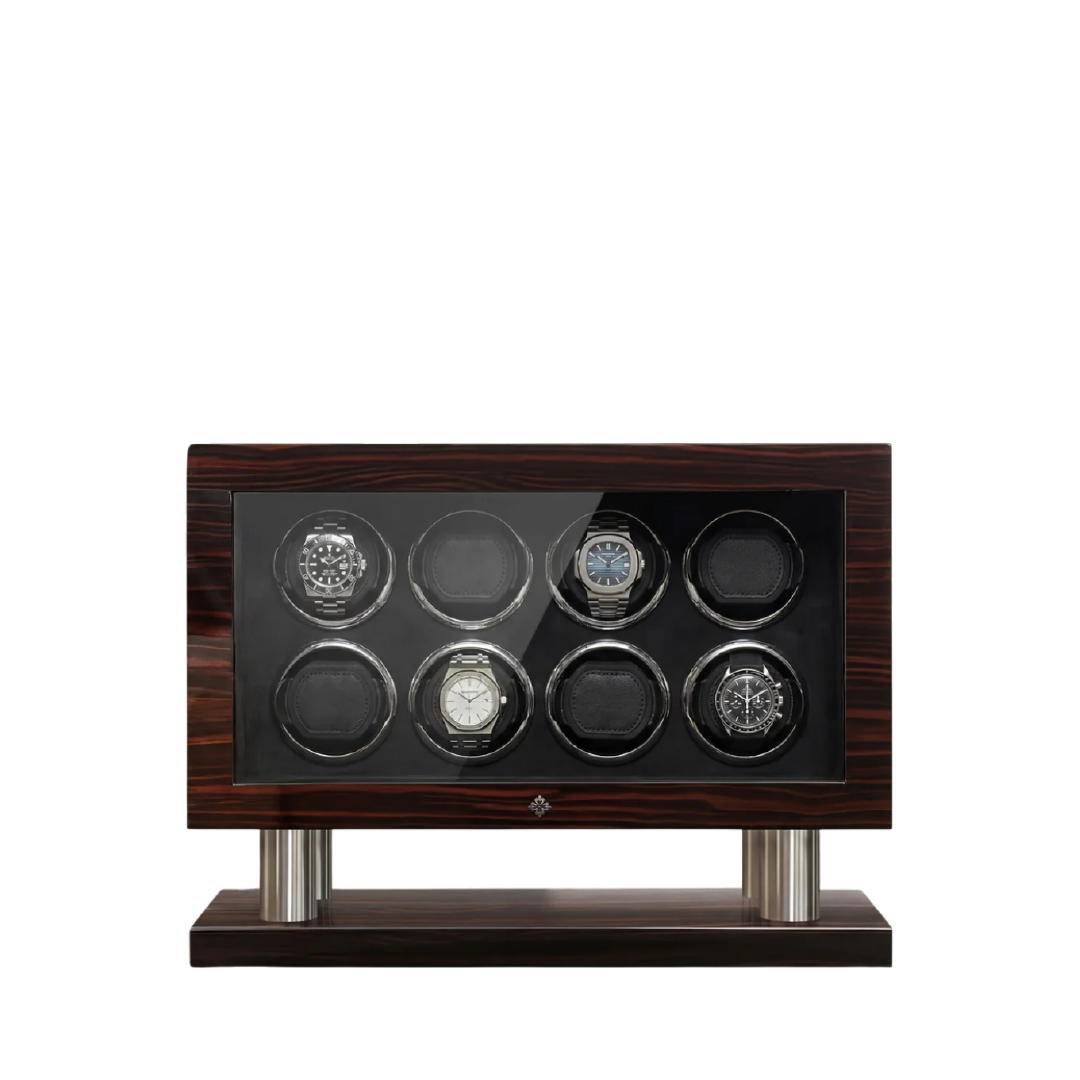
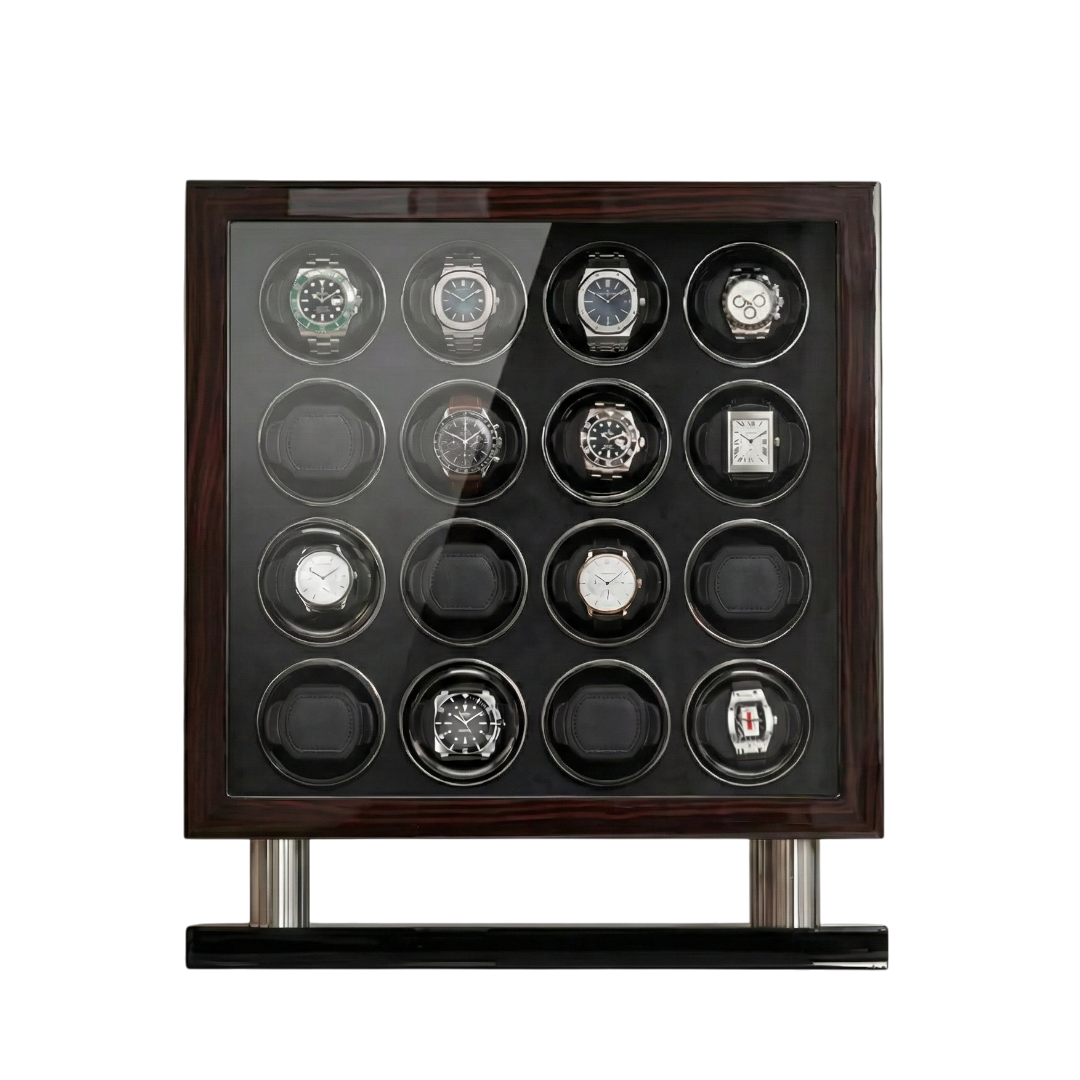
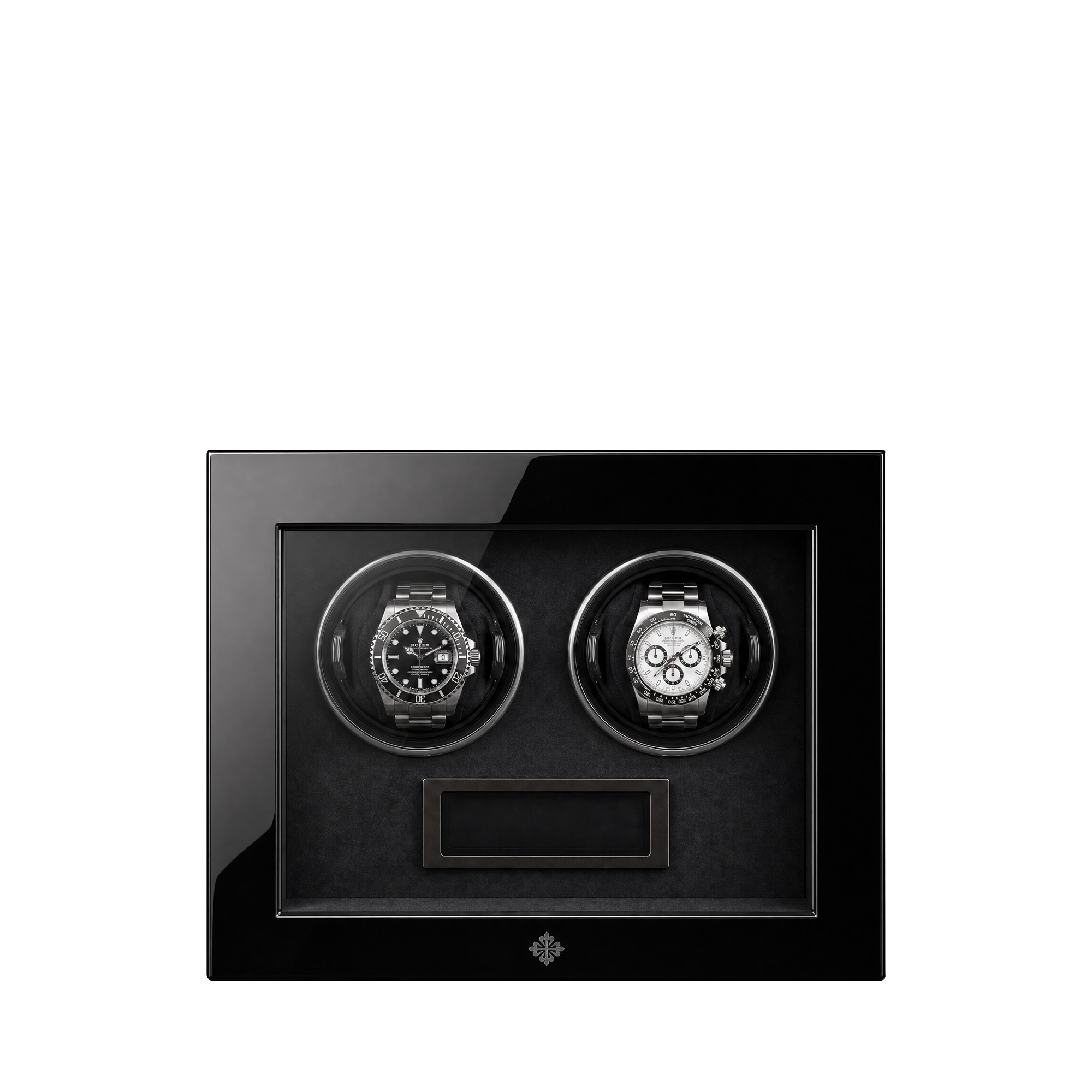
For single-watch and multi-watch storage, Enigwatch’s Impresario Series 2 watch winder accommodates oversized cases and offers the bidirectional + rest-interval programming described above.
Troubleshooting
The Luminor stops overnight even with the winder running.
TPD is too low, or the rotation direction is wrong for the caliber. Increase TPD by 100 and verify direction per Step 3. Also confirm the holder grip is tight — a slipping watch does not actually wind.
The winder is running but the power reserve is not increasing.
For ETA 6497/6498-based models: the winder is almost certainly set to CCW only. Switch to CW only immediately. For P.9000 models: confirm the winder is completing full rotations, not just oscillating back and forth within a 180-degree arc — some budget winders “bounce” rather than rotate.
The watch gains significant time after placement in the winder.
This typically indicates the winder generates magnetic interference. Position the winder at least 15cm from the watch crown axis, or use a winder with an anti-magnetic housing. Panerai in-house calibers have moderate magnetic resistance but are not immune.
The watch runs fine but the winder motor is loud.
Luminor cases are dense and heavy. A winder motor rated for lighter watches will strain and vibrate. Verify the winder’s stated maximum case weight. The Luminor 44mm steel with strap can exceed 140g total.
The Luminor crown lever keeps disengaging during winding.
The crown lever is not fully locked. Remove the watch, push the lever flush to the case until it clicks, then remount. Never place a Luminor in a winder with the crown lever in the open position — the rotating motion can engage and disengage the crown repeatedly, which is not how the mechanism is designed to operate.
Winder shuts off mid-cycle unexpectedly.
Check power supply voltage. Luminor winders running on inadequate voltage lose torque under load. Use the OEM power supply or a rated replacement.
Tools and resources
- Panerai caliber documentation (included in original purchase papers or downloadable from Panerai’s service portal)
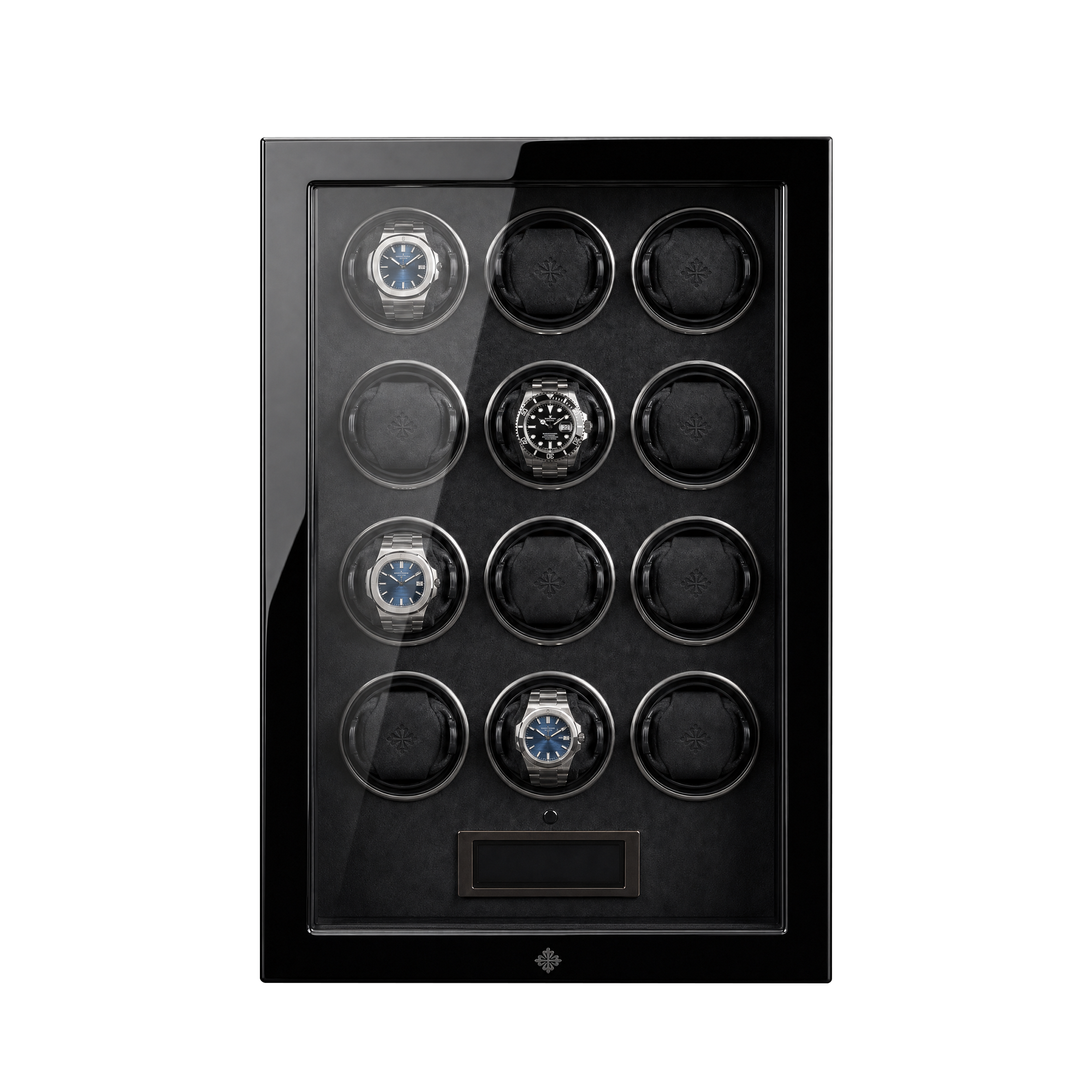
- A programmable watch winder with bidirectional rotation and adjustable TPD — Enigwatch’s Virtuoso Series 6 watch winder supports all settings outlined above
- TPD reference chart (this article’s table in Step 2)
- A non-magnetic storage surface if the winder lacks a shielded housing
- For collectors storing multiple pieces alongside the Luminor, the guide on how to set TPD on a luxury watch winder covers multi-watch programming in detail
What to do next
Once the Luminor is dialed in, the natural next step is confirming the rest of your collection is programmed correctly. Panerai Luminor settings differ meaningfully from Omega, IWC, or Rolex calibers — TPD ranges and direction requirements vary by brand and even by model year. The guide on how to pick a watch winder TPD for Omega walks through the same step-by-step logic for Omega movements if you run a mixed collection.
FAQ
What TPD should I set for a Panerai Luminor?
650–900 TPD covers every current Luminor caliber. Start at 650 TPD and increase by 100 if the watch stops; most P.9000-based models run perfectly at 700–750 TPD.
Should a Panerai Luminor winder go clockwise or counterclockwise?
Bidirectional for all in-house P-series calibers (P.9000, P.3000, and variants). Clockwise only for ETA 6497 and 6498 movements. Check the caseback for the caliber number before setting direction.
Can I leave my Panerai in a watch winder permanently?
Yes, with correct settings. The 72-hour power reserve means the movement is not under constant winding pressure. Use rest intervals (30 minutes on, 60–90 minutes off) and the watch will run indefinitely in the winder without harm.
Is 1,800 TPD too high for a Panerai Luminor?
1,800 TPD is more than double what a P.9000 needs. It will not immediately damage the movement, but it adds unnecessary rotor bearing wear over months. Cap at 900 TPD.
What happens if I use the wrong rotation direction on a Panerai?
For P-series in-house calibers, wrong direction (CCW on a CW-only movement) means the rotor spins without engaging the winding train — the watch simply runs down. For ETA 6497/6498, CCW-only completely fails to wind the movement.
How do I know if my Panerai Luminor winder settings are correct?
Wind the watch fully by hand, place it in the winder for 48 hours without wearing it, then check the power reserve. If the reserve reads full (or the watch is still running accurately), the settings are correct.
Does a Panerai Luminor need a special winder because of its size?
Yes — specifically, a winder with a holder rated for cases 44mm or larger. The standard 38–42mm watch pillow will not seat a 47mm Panerai case properly and risks crown-lever contact during rotation.
How long does it take for a winder to fully charge a Panerai Luminor P.9000?
From completely stopped, a properly set winder fully charges a P.9000 in approximately 4–6 hours of active winding time. At 30-minutes-on cycles, that means full charge within the first day of use.
One last thing
Panerai specifies a service interval of 5 years for the P.9000 caliber. If your Luminor has been sitting in a drawer — wound manually only on wear days — the lubricants in the movement may have migrated unevenly. The first time you place a long-resting Luminor in a winder, run it at the minimum recommended TPD (650) for the first week before stepping up. A gradual reintroduction to powered winding is easier on aged lubricants than jumping straight to continuous high-TPD cycles.
Related guides
Protect Your Watch Collection
Designed for collectors who demand the best. Explore our premium watch winders and luxury safes.