
Turns Per Day

Look for watch winder TPD (Turns Per Day) settings for famous brands

Automatic Watch Winder TPD Setting

What Turns Per Day (TPD) Represents?

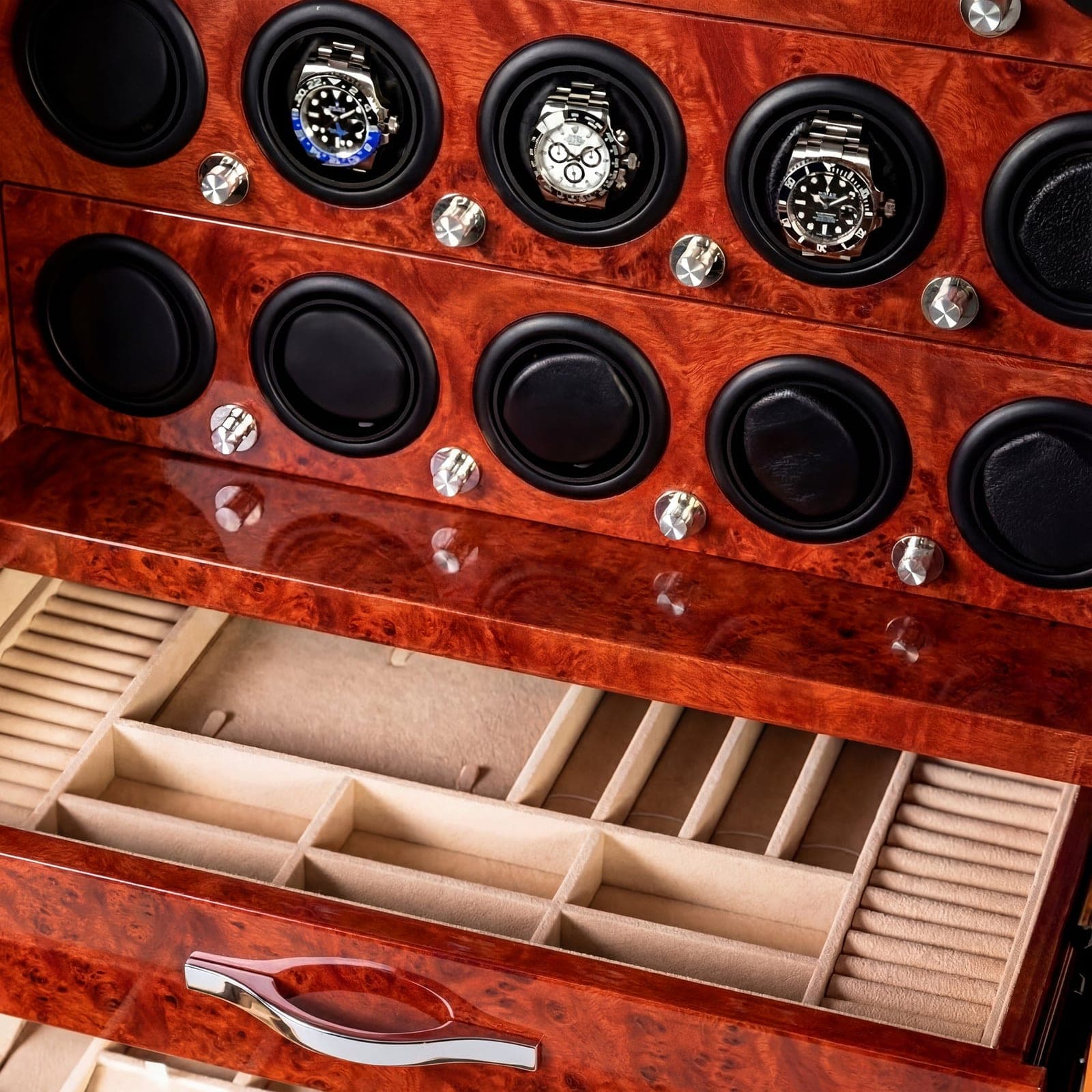
Turns Per Day, commonly abbreviated as TPD, is a measurement used to describe the total number of rotations a watch winder applies to a watch within a 24-hour period. From a technical perspective, TPD is a cumulative metric rather than a measure of speed or intensity. It reflects how much rotational movement is delivered over time, not how fast or continuously that movement occurs.

Why Automatic Watches Do Not Require Continuous Motion?

Automatic watches are designed to store energy gradually through accumulated movement rather than through constant activity. The internal winding mechanism responds to intermittent motion, allowing the mainspring to build and retain power over time. As a result, continuous rotation is neither necessary nor representative of how automatic movements operate in real-world conditions.

From a mechanical standpoint, the winding system inside an automatic watch is engineered to accept energy in bursts. Wrist movement during daily wear is irregular, consisting of short periods of motion followed by rest. The watch’s power reserve is designed to accommodate these patterns, maintaining operation even when movement is sporadic. Continuous motion does not improve this process once the power reserve is sufficiently charged.

Watch winders reflect this principle by incorporating rest periods into their motion cycles. Rather than applying constant rotation, well-designed systems deliver motion intermittently, allowing the movement to wind naturally and then pause. These pauses help limit unnecessary mechanical activity while still maintaining operational readiness.

It is also important to recognize that once a watch’s power reserve is full, additional motion does not increase stored energy. Modern automatic movements are designed with mechanisms that prevent overwinding, allowing excess motion to be dissipated safely. This means that maintaining a watch does not require maximizing activity, but rather ensuring that sufficient motion is delivered over time.

Understanding that automatic watches do not require continuous motion helps clarify the purpose of TPD. The metric exists to describe accumulated movement, not to justify constant rotation. This distinction is central to using motion systems in a way that aligns with how mechanical watches are designed to function.

How TPD Is Determined at a Mechanical Level

TPD Is an Estimate, Not a Requirement

TPD values are not fixed mechanical requirements. They are estimates based on how automatic movements convert wrist motion into stored energy. At a mechanical level, this depends on the efficiency of the rotor system, the gearing that transfers motion to the mainspring, and the overall power-reserve design of the movement.

Why Movements Respond Differently to Motion

Different automatic movements respond differently to motion. Factors such as rotor mass, winding direction, gear ratios, and internal friction all influence how effectively rotational movement winds the mainspring. Because of these differences, the amount of motion needed to maintain a full power reserve varies from one movement to another.

Why TPD Is Expressed as a Range

Manufacturers and technical references determine approximate TPD ranges through observation and testing rather than precise calculation. These ranges reflect the accumulated motion that is generally sufficient to keep a watch running under normal conditions, not a minimum threshold that must be met at all times.

TPD in Real-World Use

Real-world wear introduces variability that cannot be replicated mechanically. Wrist motion differs between individuals and from day to day. As a result, TPD functions as a practical guideline rather than a strict mechanical specification, providing a common reference rather than an exact requirement.

Understanding how TPD values are derived helps place them in context: they describe typical behavior across a range of movements rather than precise mechanical limits, which is why flexibility and tolerance are inherent to their use.

Directional Winding and Its Impact on TPD

The Role of Rotation Direction in TPD

The effectiveness of a given TPD value is influenced not only by the amount of rotation delivered, but also by the direction in which that rotation occurs. Automatic watch movements can be designed to wind in one direction only or in both directions, and this difference affects how accumulated motion translates into stored energy.

Using TPD Data Responsibly

TPD data is most effective when applied with an understanding of its limitations. Higher TPD values do not inherently produce better outcomes, nor do they indicate improved performance once a watch’s power reserve is adequately maintained.

From an engineering perspective, excessive motion does not increase stored energy beyond the design limits of the movement. Modern automatic watches include mechanisms that prevent overwinding, allowing surplus motion to dissipate safely. This means that modest variation in motion delivery is generally inconsequential as long as sufficient movement is provided over time.

TPD data is also not a substitute for regular wear. Watches worn frequently will receive motion that naturally exceeds most mechanical rotation programs. In these cases, TPD serves primarily as a reference for periods of non-use rather than as a constant operational requirement.

Using TPD data responsibly involves recognizing when precision matters and when it does not. The goal is to maintain operational readiness without introducing unnecessary concern or adjustment. Viewing TPD as a guiding metric rather than a rule helps align motion systems with how mechanical watches are designed to function.

Interpreting motion ranges

 Interpreting Published TPD Ranges

Published TPD values are commonly presented as ranges rather than fixed numbers, and this format reflects how automatic movements behave in practice. These ranges acknowledge natural variation in winding efficiency, wear patterns, and mechanical tolerances across different watches.

TPD Ranges as Operating Windows

A TPD range is an estimated operating window where enough motion is delivered to help maintain a watch’s power reserve under typical conditions. It is guidance, not a strict target.

Small differences above or below a published range usually have little practical impact in day to day use, especially when the watch is also worn regularly.

Why Published Ranges Differ

Different manufacturers and reference sources often publish different TPD ranges for similar movements. Variation usually comes from testing methods, wear assumptions, and conservative safety margins.

Because TPD is an approximation, it is normal to see overlapping ranges or small inconsistencies across sources. That does not necessarily indicate an error.

TPD vs. Real-World Wear

Real-world wrist movement can exceed the motion delivered by a winder during daily activities. In that context, TPD should be treated as supportive guidance rather than a strict mechanical requirement.

The most useful way to interpret TPD is as a flexible reference point that helps set reasonable rotation patterns, not as an exact threshold that must be met.

Reference TPD Table

TPD reference tables compile commonly cited ranges for different watch movements to provide general guidance on motion requirements. These tables are intended to support understanding rather than dictate exact configuration, and they should be interpreted in the context of the broader principles outlined above.

The reference data hosted on Enigwatch’s TPD page reflects commonly accepted ranges drawn from manufacturer information and technical observation. These values represent typical guidance rather than fixed requirements and may vary depending on individual movement characteristics and wear patterns.

When using reference tables, it is important to treat the data as informational. Differences between published sources are normal, and small deviations in applied motion are unlikely to affect performance. The table serves as a starting point for understanding motion needs, not as a precise specification.

Technical Summary

Turns Per Day is a cumulative measure used to describe how much rotational movement a watch winder delivers over a 24-hour period. It reflects accumulated motion rather than speed or intensity and exists to approximate the winding effect of daily wear.

TPD values are derived from general observations of how automatic movements respond to motion and are expressed as ranges to account for variability in movement design and real-world behavior. Directional winding, rest cycles, and power reserve design all influence how motion is converted into stored energy.

Understanding TPD as a flexible reference rather than a strict requirement helps place it in proper context. When applied responsibly, TPD data supports controlled motion delivery without unnecessary complexity, aligning mechanical systems with the way automatic watches are designed to operate.