
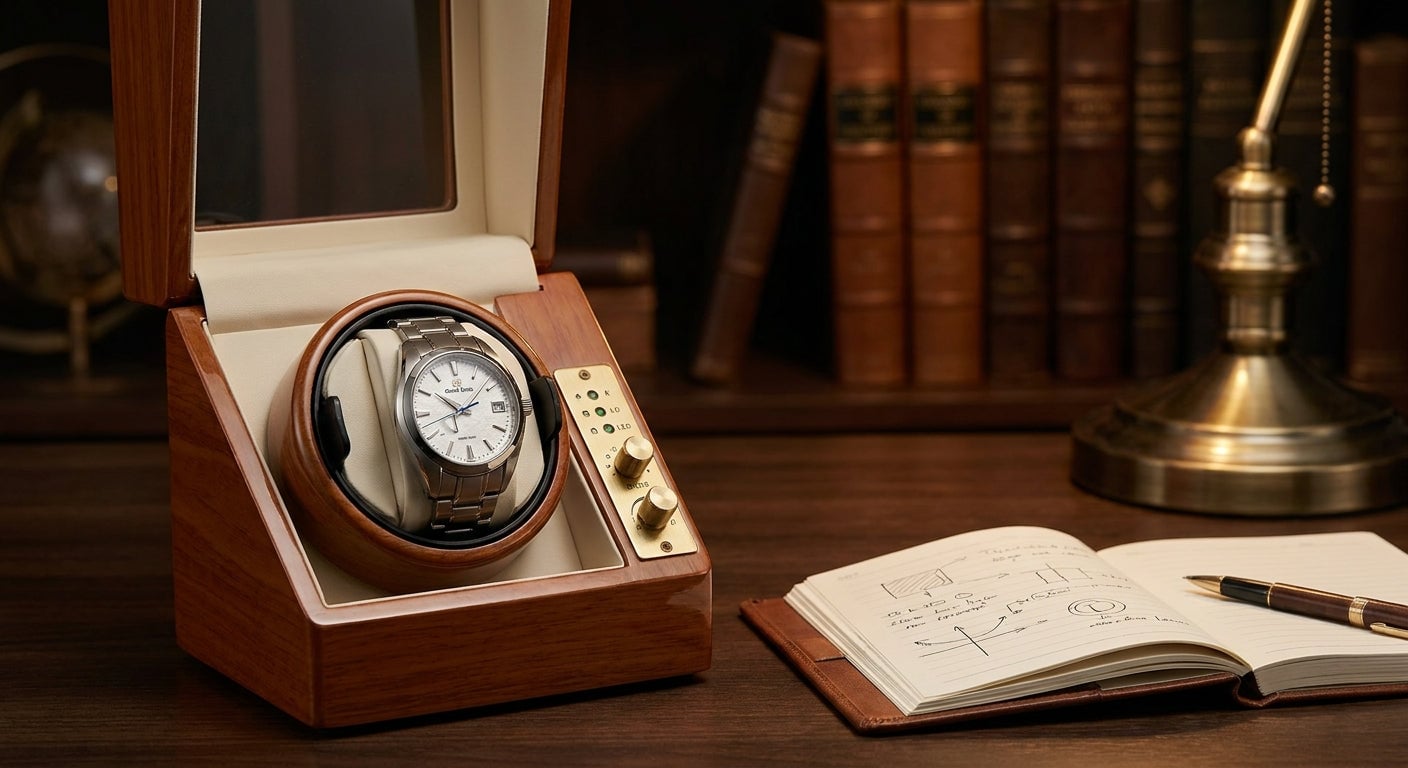
The Grand Seiko Spring Drive is one of the most mechanically specific automatic watches on the market, and getting your watch winder settings wrong risks over-winding the glide spring or leaving the mainspring perpetually under-wound. This guide gives you the exact turns-per-day, direction, and rest-cycle settings to keep every Spring Drive caliber running accurately in 2026.
TL;DR: Grand Seiko Spring Drive movements need 650–800 TPD (turns per day), bidirectional rotation, and a 4–6 hour rest period every 24 hours. Most calibers — including the 9R65, 9R96, and 9R31 — share this window. Set your winder to those parameters and the watch stays within the Spring Drive’s ±1 second-per-day accuracy specification. Enigwatch winders with per-module TPD control handle this without compromise.
Why the Spring Drive Is Different From Every Other Automatic
The Spring Drive does not use a standard lever escapement. Power from the mainspring flows through a glide wheel regulated by an electromagnetic brake — a tri-synchro regulator that Grand Seiko has been refining since the caliber’s commercial debut in 1999. That mechanism is sensitive to power reserve extremes in a way that a conventional ETA or Rolex cal. isn’t.
Set TPD too low (under 500) and the mainspring never reaches optimal tension. Set it too high (above 1,000 for extended periods) and the glide spring endures unnecessary stress. The Spring Drive’s rated power reserve ranges from 72 hours on the 9R65 to 84 hours on the 9R96 Snowflake, which means you have more margin than a Rolex with a 48-hour reserve — but that margin does not excuse sloppy winder programming in 2026.
What You’ll Need
- A winder with independently programmable TPD per module (not a global setting shared across all slots)
- TPD range covering at least 500–900 TPD
- Bidirectional rotation mode (CW+CCW)
- Programmable rest intervals (minimum 4 hours off per 24-hour cycle)
- A watch holder with a cushion sized for Grand Seiko’s typically wider lugs (40–44 mm cases are standard across the Spring Drive line)
Step-by-Step: Programming Watch Winder Settings for Grand Seiko Spring Drive
Step 1 — Identify your specific caliber
Flip the watch over or check Grand Seiko’s published caliber sheet. The model number on the caseback tells you the caliber family.
- 9R65 — 72-hour power reserve, bidirectional winding rotor
- 9R96 — 84-hour power reserve (Snowflake, Seasons models), bidirectional
- 9R31 — 72-hour power reserve, bidirectional
- 9RA5 — Spring Drive with Dual Impulse Escapement, bidirectional, found in hi-beat Elegance Collection pieces
All four calibers share the same winder direction requirement: bidirectional. None wind exclusively clockwise or counterclockwise. If your winder only offers CW or CCW as separate fixed modes, you must set it to alternate — not lock into one direction.
Why it matters: Grand Seiko’s rotor engages in both directions. Forcing unidirectional winding on a bidirectional rotor doesn’t damage the movement immediately, but it creates uneven wear on the reversing wheel assembly over 12–18 months.
Common mistake: Owners of earlier Rolex-tuned winders copy their Rolex CW-only setting directly to a Spring Drive slot. That is wrong. Expected outcome after Step 1: you know your caliber and have confirmed bidirectional is required.
Step 2 — Set TPD to 650–800
Navigate to your winder’s per-module TPD menu. Enter a value between 650 and 800 TPD.
The midpoint — 720 TPD — is the safest general setting for the 9R65 and 9R31. For the 9R96 with its 84-hour reserve, you can go as low as 650 TPD and still maintain full power reserve because the longer mainspring stores energy more efficiently.
Why it matters: Grand Seiko’s own service documentation (published in Japanese but translated by authorized service centers) cites a winding efficiency range consistent with 600–850 TPD for Spring Drive calibers. Staying in the 650–800 band keeps you well inside that window with buffer on both ends.
Common mistake: Defaulting to 1,000 TPD because “higher is safer.” It is not. Sustained over-winding stresses the tri-synchro regulator’s magnetic brake coil and accelerates mainspring fatigue. Expected outcome after Step 2: TPD locked at 650–800 on the Spring Drive module.
Step 3 — Set rotation direction to bidirectional (CW+CCW)
Select the bidirectional mode on your winder’s direction setting. If your winder labels this “Alt,” “Both,” or “CW+CCW,” all three mean the same thing.
Why it matters: Single-direction winding on a bidirectional rotor means roughly half of all wrist motion equivalent is wasted. Your watch may still stay wound — but it is working harder to get there.
Common mistake: Confusing “alternating” (the motor reverses direction each cycle) with “simultaneous” (a mechanical impossible). Alternating is correct. Expected outcome after Step 3: the module rotates clockwise for one programmed cycle, then counterclockwise for the next.
Step 4 — Program a rest interval of 4–6 hours per 24-hour cycle
Most quality winders break the 24-hour day into active and rest periods. Set the rest window to at least 4 hours. A 6-hour rest is preferable if your winder allows that granularity.
Why it matters: The Spring Drive’s glide spring needs static time to settle. Continuous rotation without rest keeps the mainspring at peak tension around the clock, which accumulates wear on the tri-synchro regulator’s components faster than intermittent winding does. Grand Seiko recommends against storing any Spring Drive in a fully-locked power state indefinitely.
Common mistake: Setting the winder to “continuous” mode because the watch never stopped running when it was at maximum run time. Continuous mode is for watches with sub-40-hour power reserves that need constant topping. The 9R65’s 72-hour reserve means you have significant margin for rest cycles. Expected outcome after Step 4: the winder runs for 18–20 hours and rests for 4–6 hours within each 24-hour period.
Step 5 — Fit the watch to the correct holder diameter
Grand Seiko Spring Drive cases run 37–44.2 mm depending on the collection — SBGA (Snowflake), SBGE (Sports), and SBGW (Elegance) all differ. Use a holder cushion that grips the spring-bar area without pressing on the crown or pushers.
Why it matters: An ill-fitting holder can apply lateral pressure on the crown, which risks nudging the setting position and disrupting the calendar or time display on models with complications.
Common mistake: Using the same small-diameter cushion as a dress watch. Spring Drive Sport models like the SBGE253 measure 44.2 mm — they need a large-lug holder. Expected outcome after Step 5: the watch sits centered, crown clear of the holder wall, and rotates without wobble.
Step 6 — Verify accuracy after 72 hours
After three days on the winder, time the watch against a GPS reference or a verified timegrapher app. The Spring Drive should deliver ±1 second per day when wound correctly. If you are seeing ±3 seconds or more, adjust TPD down by 50 units and retest.
Why it matters: The tri-synchro regulator is self-correcting by design, but it operates most accurately at the right tension. Deviation above ±2 seconds per day when the watch is fresh from service is a reliable indicator that winding parameters are off.
Common mistake: Comparing to a standard mechanical tolerance. The Spring Drive is not a standard mechanical — its ±1 second specification is a real, achievable target, not a marketing floor. Expected outcome after Step 6: confirmed accuracy within Grand Seiko’s published ±1 second/day specification.
Troubleshooting
Watch stops overnight despite being on the winder. TPD is too low or rest interval is too long. Raise TPD to 800 and shorten rest to 4 hours.
Seconds hand sweeping unevenly (not the normal Spring Drive glide). This points to power reserve inconsistency. Check that direction is set to bidirectional — a CW-only setting cuts effective winding by up to 40% on some calibers.
Crown feels stiff after removing from winder. The holder is pressing against the crown. Refit to a larger-diameter cushion or reposition the watch so the crown faces away from the holder wall.
Watch gains 3+ seconds per day consistently. Mainspring is over-wound from sustained high TPD. Drop to 650 TPD and allow a 48-hour manual rest off the winder to let the spring settle.
Winder noise audible at night. Motor quality matters. Budget winders with direct-drive motors produce vibration that transmits through the case. A winder using a quiet, belt-driven or gear-isolated motor running at the correct TPD eliminates this.
Watch loses accuracy after a month on the winder despite correct settings. Schedule a service check — the Spring Drive’s glide spring and mainspring are assessed every 3–5 years. No winder compensates for a watch that needs servicing.
Tools and Resources
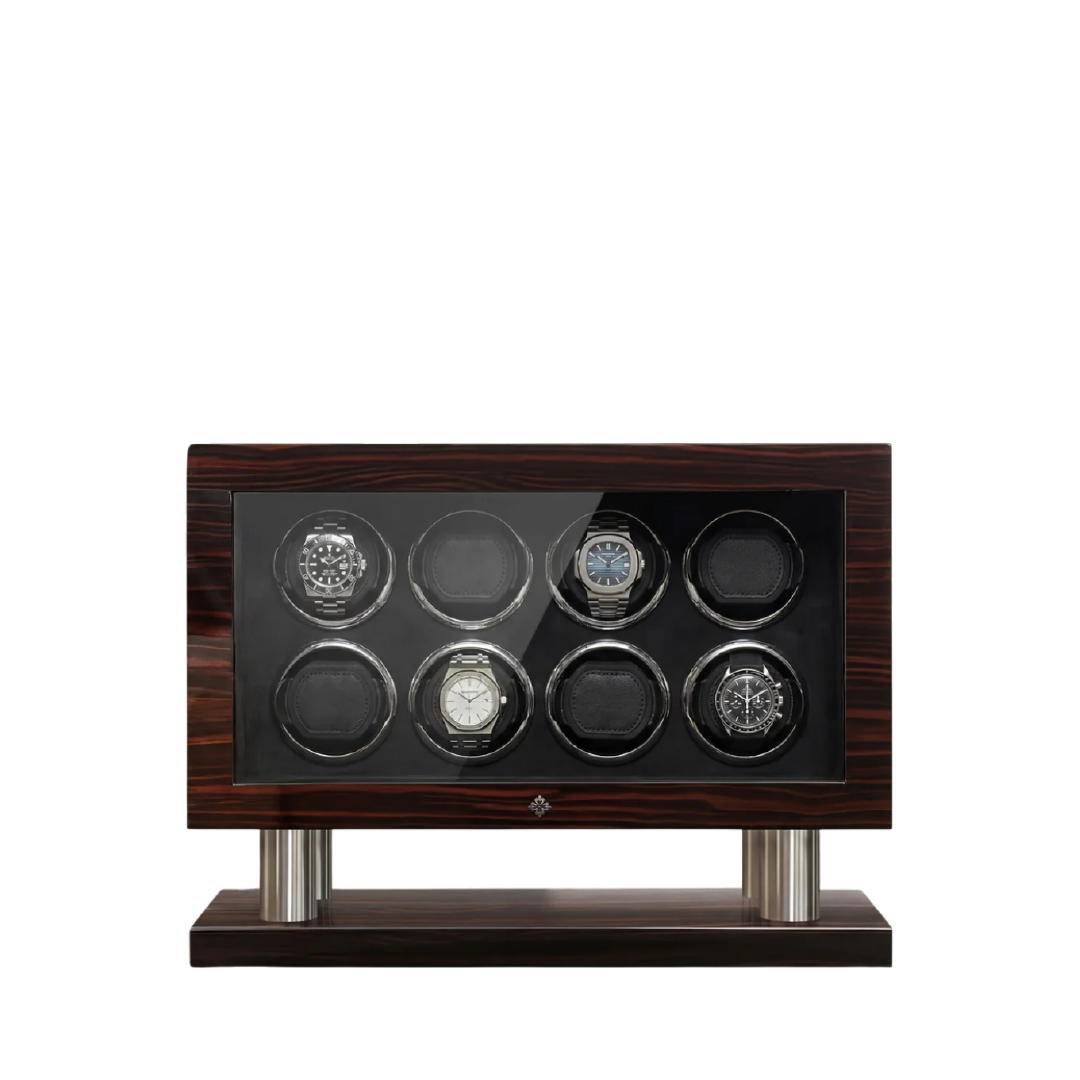
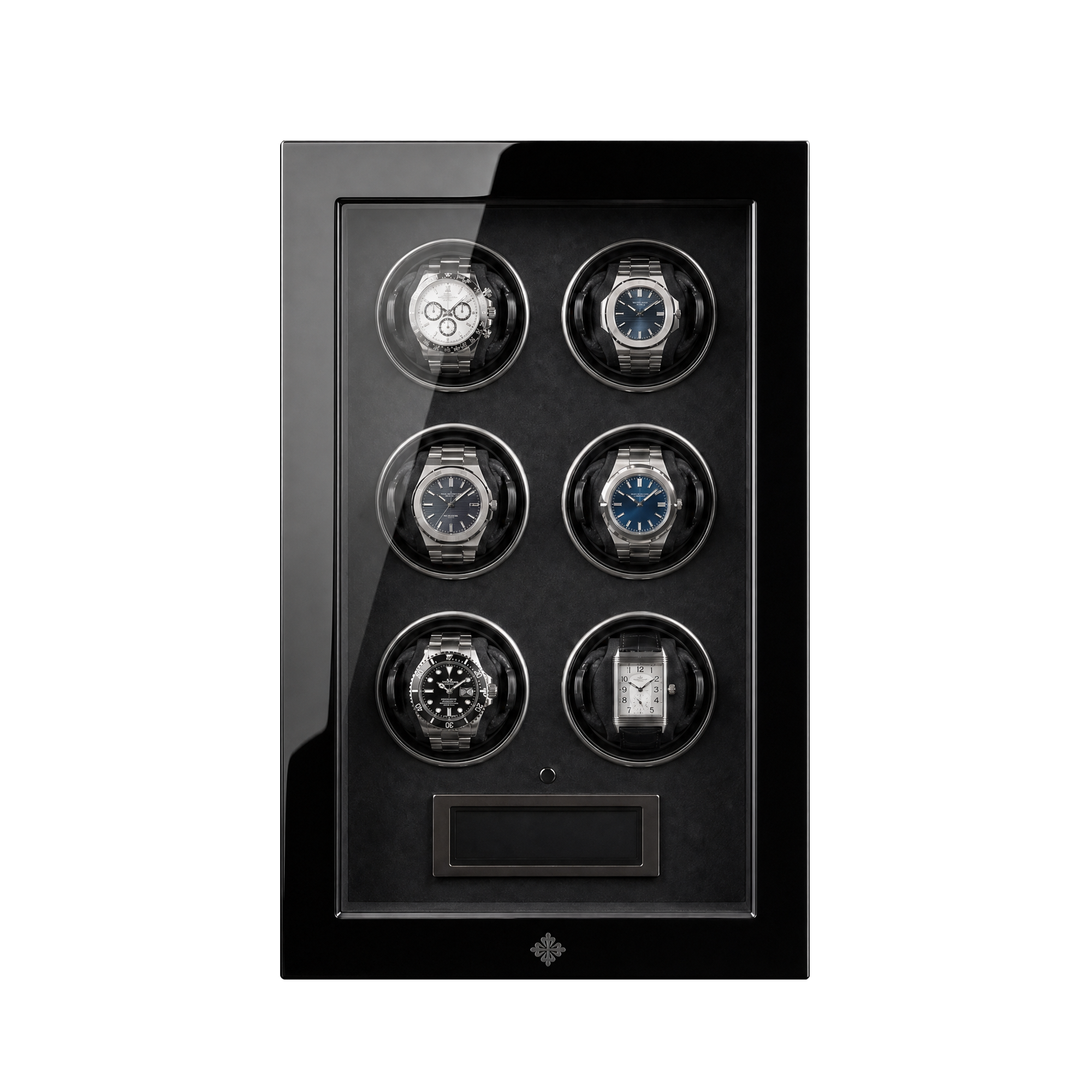
- A winder with independent per-module programming — the Impresario Series 6 watch winder supports per-slot TPD and bidirectional control, accommodating mixed collections where one slot holds a Spring Drive and another holds a Rolex
- Timegrapher app (iOS or Android) — free rate-testing without workshop equipment
- Grand Seiko’s published caliber data — available through authorized dealers and the Grand Seiko website, lists rotor direction and power reserve by reference
- How to pick a watch winder TPD for Omega — same methodology applied to Omega calibers, useful if you store Spring Drive and Omega movements side by side
What to Do Next
If you own more than one automatic alongside the Spring Drive, read how to choose a watch winder for 8 watches — it covers how to match TPD profiles across mixed-brand collections without compromising any single movement.
FAQ
What TPD should I use for a Grand Seiko Spring Drive?
650–800 TPD is the correct range for all current Spring Drive calibers, including the 9R65, 9R96, and 9RA5. 720 TPD is a safe midpoint for most owners in 2026.
Should my watch winder rotate clockwise or counterclockwise for a Spring Drive?
Bidirectional — the Spring Drive rotor engages in both directions. CW-only or CCW-only will reduce winding efficiency and cause uneven wear on the reversing wheel over time.
Can I use the same winder settings for Grand Seiko and Rolex?
No. Rolex movements typically require CW-only rotation at 650–950 TPD. Spring Drive requires bidirectional at 650–800 TPD. A winder with independent per-module settings handles both without compromise.
How many hours should the winder rest each day for a Spring Drive?
4–6 hours of rest per 24-hour cycle. The 9R65’s 72-hour power reserve provides enough buffer that the watch will not stop during a 6-hour rest window.
Will a watch winder damage my Grand Seiko Spring Drive?
Only if settings are wrong. Correct TPD (650–800), bidirectional rotation, and daily rest intervals pose no risk to the movement. Sustained over-winding above 1,000 TPD is the primary damage vector to avoid.
What happens if I set TPD too high for a Spring Drive?
The mainspring stays at or near full wind continuously. Over months, this accelerates fatigue in the tri-synchro regulator components and may reduce accuracy. Drop to 650–800 TPD and allow the watch a 48-hour rest off the winder to normalize.
Do all Grand Seiko movements need the same winder settings?
Spring Drive calibers all share the bidirectional + 650–800 TPD requirement. Grand Seiko’s conventional automatic calibers (non-Spring Drive) use a different rotor system and may accept higher TPD. Check the caseback for the caliber number before setting.
Is 800 TPD safe for the 9R96 Snowflake?
Yes — the 9R96’s 84-hour power reserve means it absorbs higher TPD without straining the mainspring. 800 TPD is within the safe ceiling for 2026 programming recommendations.
One Last Thing
The Spring Drive’s glide wheel operates at exactly 8 Hz — 8 rotations per second — controlled electromagnetically rather than mechanically. That is why the seconds hand glides rather than ticks, and it is also why over-winding creates a measurably different stress profile than it does in a lever-escapement watch. The right winder settings are not just housekeeping — they are directly protecting a mechanism that Grand Seiko took 28 years and over 600 prototype iterations to bring to market.
Protect Your Watch Collection
Designed for collectors who demand the best. Explore our premium watch winders and luxury safes.