
A USB-powered watch winder works as well as a plug-in model only when the motor keeps a steady turns-per-day count under a straight 5V/1A (5W) USB draw — most don't, because voltage sags the moment the port shares power with anything else. The hidden cost the marketing skips: a USB winder pulling from a shared hub or an aging power bank can drift 15-20% off its programmed TPD without ever throwing an error.
- A usb powered watch winder only matches plug-in performance when voltage stays fixed at 5V/1A — shared hubs and power banks rarely hold that line.
- Plug-in winders run on 12V wall adapters that don’t sag under load, which is why Enigwatch builds its motors around AC power.
- Automatic calibers generally need 650-950 TPD; voltage drops below spec on USB rigs stall winders mid-cycle.
- Verdict for 2026: USB winders suit a single travel watch on a short trip, not a Rolex or Patek Philippe left running for weeks.
Why this matters
A watch winder's whole job is repeating one motion at a fixed rate for weeks at a time. Torque consistency, not raw power, is what keeps a caliber wound correctly — and consistency is exactly what a shared USB line can't promise.
Drop the voltage mid-cycle and a Mabuchi-style gear motor either slows its rotation or stalls for a beat before restarting. Neither shows up on a spec sheet, but both throw off the programmed TPD your watch actually needs in 2026.
How to tell if a USB-powered watch winder works as well as plug-in
Check the winder against a plug-in unit on three things: voltage stability, rated wattage, and what happens when the rotation program calls for bi-directional turns.
| Power source | Typical output | Torque under load | Best for |
|---|---|---|---|
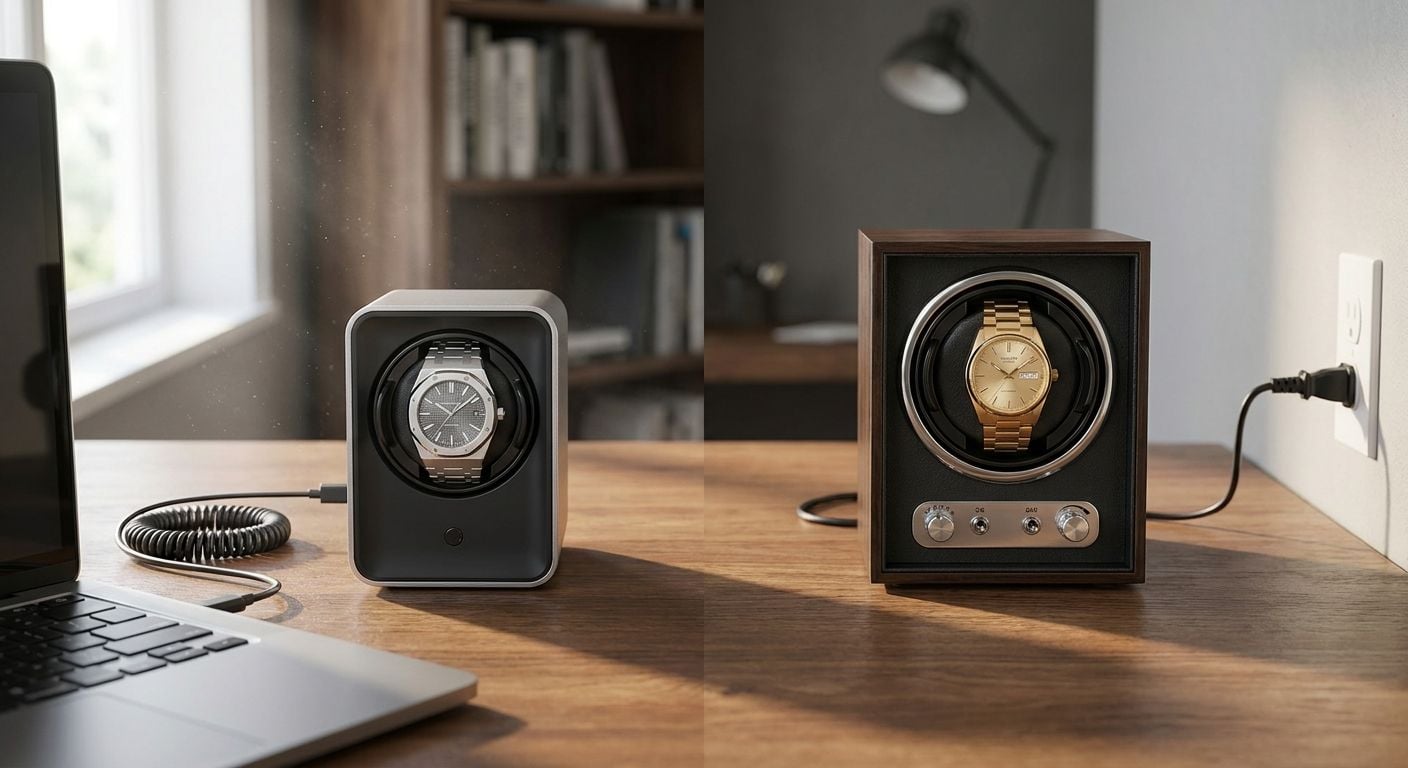
| USB-powered winder | 5V, ~1A (5W) | Drops when sharing a hub, laptop port, or aging power bank | A single travel watch, short trips |
| Plug-in (AC) winder | 12V wall adapter | Stays fixed regardless of what else is plugged in | Daily display, multi-watch cabinets, high-beat calibers |
If the winder you're testing runs quiet and hits its TPD count within a few percent over a week of continuous logging, it's holding up. If rotations slow noticeably after a few hours or the motor makes a stutter-step sound, the voltage is sagging. For a full walkthrough of what a healthy cycle should look like, how to tell if your watch winder is working correctly covers the physical checks step by step. A quick primer on wall power itself lives in voltage explained for 110V and 220V compatibility.
USB-Powered Winders: 5V/1A (5W) Draw
Most USB-A ports cap out at 5V and roughly 1A, which lands around 5W of usable power. That's enough to spin a light rotor for a single watch, but the margin disappears fast once the winder shares a port with a hub, a laptop, or a multi-device power bank.
- Pros: portable, works off a battery pack, no wall outlet needed.
- Cons: voltage sags under shared load, weaker torque on multi-mode programs, shorter duty cycle before a power bank needs a recharge.
- Verdict: Buy for a single travel watch you wind for a week at a time. Skip for a primary daily driver.
Plug-In Winders: 12V Wall Adapters, Steady Torque
A plug-in winder draws from a dedicated 12V wall adapter that doesn't care what else is running in the house. No shared bandwidth, no voltage competing with a phone charger on the same hub.
- Pros: consistent torque regardless of rotation complexity, handles bi-directional and multi-TPD programs without stalling, holds spec for years of continuous use.
- Cons: needs a fixed outlet, not something you toss in a carry-on.
- Verdict: Buy for anything you're leaving running long-term — a Daytona, a GMT-Master, a perpetual calendar.
Enigwatch builds its watch winder line around Japanese Mabuchi motors on AC power for exactly this reason: torque has to stay fixed whether the program is a single clockwise TPD run or a mixed bi-directional cycle for a GMT movement.
Why USB watch winder performance varies
- Shared hub load — a USB hub feeding a monitor, a phone, and a winder off one port splits the available current three ways.
- Power bank age — lithium cells lose peak output capacity after repeated charge cycles, which shows up as slower rotation near the end of a charge.
- Cable gauge and length — thin charging cables over 3 feet drop measurable voltage before it reaches the motor.
- Motor type — gear-reduction DC motors built for steady voltage stall sooner than direct-drive motors when input dips.
- Rotation program complexity — bi-directional or high-TPD programs demand more consistent torque than a simple single-direction cycle.
- Wall adapter regulation — a dedicated 12V supply doesn't fluctuate the way a shared USB rail does, which is the core gap between the two power types.
Some collectors solve the portability problem by pairing a winder with the same portable USB power banks used for phones and laptops on a trip, but that's a stopgap for a week away, not a long-term power source for a daily-wear piece. If you're mapping out how much a winder actually costs to run either way, watch winder electricity cost breaks down the real numbers, and the difference between motor families is covered in Japanese vs Swiss motor types.
Does a USB watch winder cost less to run than a plug-in model?
A USB watch winder pulling 5V at 1A draws roughly 5W, which is marginally less than a 12V plug-in unit — but the difference amounts to pennies a month either way, not a real savings driver.
Can a USB watch winder run overnight on a power bank?
Yes, most power banks in the 10,000-20,000 mAh range can run a light-duty USB winder overnight, though output drops as the cell depletes, which can slow rotation speed in the final hour before it dies.
Is a USB watch winder strong enough for a Rolex or Patek Philippe?
A USB watch winder can run a Rolex or Patek Philippe short-term, but most automatic calibers need 650-950 TPD held steady, and a shared USB rail struggles to hold that number over weeks of continuous use. For a mixed high-value collection, checking how to check if turns per day is correct before committing to either power type is worth the ten minutes.
FAQ
What’s the best USB-powered watch winder for travel in 2026?
The best usb powered watch winder for travel is a single-watch unit rated for a steady 5V/1A draw off a dedicated power bank, not a shared hub. Reserve it for trips under two weeks; longer stretches favor a plug-in unit.
Is a USB watch winder as well as a plug-in model?
A USB watch winder works as well as a plug-in model only when the port delivers a fixed 5V/1A without competing for shared current. Under real-world conditions with hubs, laptops, or aging power banks, plug-in units hold TPD spec more reliably.
How much voltage does a watch winder need?
Most winder motors are rated for either a straight 5V USB feed or a 12V wall adapter, and the number has to stay fixed for the rotation program to hit its programmed TPD. A dropping voltage mid-cycle is the main cause of missed turns.
Can you power a watch winder off a laptop USB port?
You can power a watch winder off a laptop USB port, but laptops throttle port output when the battery is low or when other peripherals are connected. Expect inconsistent torque compared to a dedicated wall adapter.
Do USB watch winders drain power banks quickly?
USB watch winders draw a steady 5W continuously, which drains a typical power bank over one to three days depending on capacity. That’s fine for a short trip but impractical as a permanent setup.
What TPD should a watch winder run?
Most automatic calibers need 650 to 950 turns per day, though the exact figure varies by movement and should match the manufacturer’s spec. Running below that range under-winds the mainspring over time.
Does a watch winder need a dedicated wall outlet?
A plug-in watch winder needs a dedicated wall outlet to hold its 12V supply steady, which is the main reason plug-in models outperform USB units on long-term reliability. USB units skip the outlet requirement but trade away that consistency.
Will a USB watch winder damage a Rolex or Patek Philippe movement?
A USB watch winder won’t damage a Rolex or Patek Philippe movement outright, but inconsistent torque from voltage sag can under-wind the mainspring over weeks. For daily-wear pieces left running long-term, a plug-in winder is the safer call.
One last thing
Most USB-powered winders skip programmable rotation modes entirely — not by design choice, but because their onboard chips can't regulate voltage tightly enough to run a bi-directional or multi-TPD program without stalling. If the winder you're eyeing offers more than one or two fixed settings and runs on USB, ask how it holds torque under a shared load before you buy; that single question filters out most of the weak options on the market in 2026.
Related guides
Protect Your Watch Collection
Designed for collectors who demand the best. Explore our premium watch winders and luxury safes.