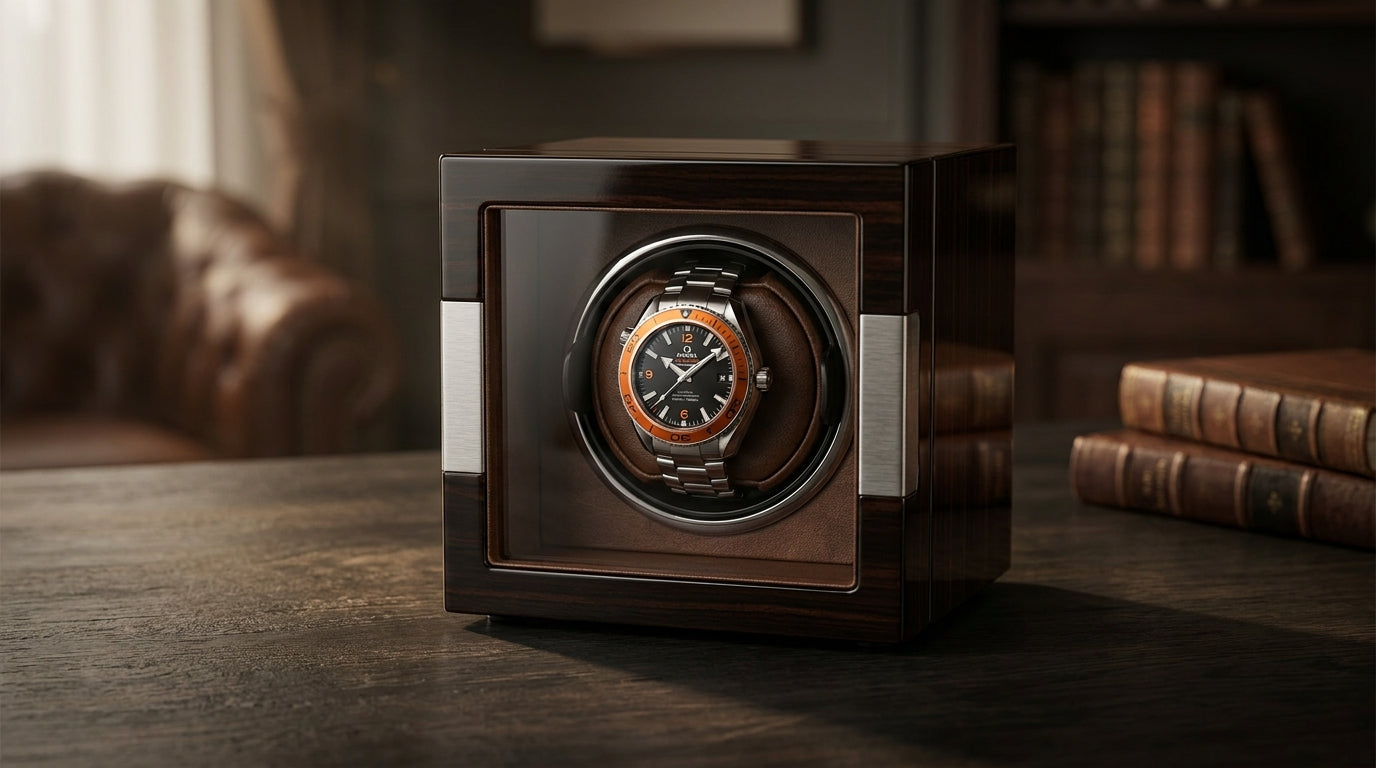
Ball automatic movements run on bidirectional oscillating weights and moderate power reserves, which means the wrong winder setting leaves you resetting the date every Monday. Here's how to match TPD and rotation direction to your Engineer Hydrocarbon, Roadmaster, or Engineer II — and which winders actually fit them.
TL;DR: Ball automatic watches — whether built on Sellita SW200/300 bases or Ball's own RR-series calibers — wind in both directions and need a winder set between 650 and 950 TPD to stay fully charged. The Impresario Series 2 Watch Winder is the Buy for a one- or two-piece Ball collection; step up to the Virtuoso or Yachtline lines once you're past three pieces. Skip any winder locked to a single unidirectional program — most Ball calibers won't wind correctly on one.
Why this matters
Ball Watch Company builds around case sizes that run 42mm to 45mm, often with a helium escape valve and a thick sapphire crystal — the Engineer Hydrocarbon line is not a slim dress piece. The calibers inside, largely Sellita-based or Ball's own RR1102/RR1103 family, wind off a rotor that swings in both directions. Set a winder to spin one way only and you're feeding roughly half the winding pulses the movement can actually use.
TPD (turns per day) is the other half of the equation. Ball's automatic calibers generally sit in the 650-950 TPD band depending on the specific movement and rotor efficiency — too few turns and the mainspring runs down between wears in 2026's typical two-to-three-day work week; too many and you're adding wear cycles for no gain. A full walkthrough of how TPD numbers map to specific calibers lives in the TPD explained: full brand reference guide if you want the long version.
Who this is for
This guide is for Ball Watch owners — Engineer Hydrocarbon, Engineer II Ohio, Roadmaster, or DLC pieces — who wear on rotation and don't want to hand-wind and reset the date every time a watch sits for more than 40 hours. If you own a single Ball piece and wear it daily, you likely don't need a winder at all. If you're rotating two or more, or you travel and want the watch ready on return, this is where TPD and direction settings actually matter.
What to look for in a watch winder for Ball automatic
Bidirectional rotation
Ball's oscillating weights wind in both directions on nearly every modern reference. A winder locked to clockwise-only or counterclockwise-only wastes half the rotor's winding potential and can leave power reserve inconsistent week to week.
TPD range of 650-950
A fixed-TPD winder set at, say, 900 turns flat will overwind lighter Ball calibers and underwind heavier ones. Look for a winder with adjustable TPD in that band rather than a single hardwired setting.
Case clearance for 42-45mm cases
The Engineer Hydrocarbon's thick profile and helium valve crown mean shallow foam cushions or narrow watch pillows leave the case sitting crooked. A crooked case winds unevenly and can strain the strap or bracelet clasp over months.
Quiet motor operation
Most Ball owners keep a winder on a dresser or nightstand rather than in a closet. A Japanese Mabuchi motor engineered for low decibel output matters more here than it does in a display case tucked away in a walk-in.
Program memory for multiple pieces
If you're rotating an Engineer Hydrocarbon alongside a Roadmaster, independent TPD and direction memory per slot means you're not resetting the program every time you swap watches in and out.
Build quality proportional to the watch
A Ball piece sits in the $2,000-$8,000 range depending on the reference. A $60 winder with a plastic gear train is a mismatch on both function and presentation.
Top picks for Ball automatic owners
The safe pick — Impresario Series 2 Watch Winder. Two independently programmable slots, Japanese Mabuchi motor, bidirectional rotation with adjustable TPD. For a two-piece Ball rotation — say an Engineer Hydrocarbon and a Roadmaster — this covers both without paying for slots you won't fill. Buy.
The growing-collection pick — Virtuoso Series 6. Six slots, same bidirectional Mabuchi-driven mechanism, Alcantara-lined compartments sized to handle the Engineer Hydrocarbon's thicker case without the watch sitting crooked. If your Ball collection is on its way past three pieces in 2026, this is the winder that won't need replacing in 18 months. Buy.
The wildcard — Yachtline Series 8 Watch Winder. Nautical-styled housing that suits Ball's dive-watch heritage, eight independently programmable slots, same bidirectional TPD range. It costs more than the Virtuoso for two extra slots, so it's a Consider unless you're specifically drawn to the design language or you need the extra capacity now rather than later.
What to avoid
- Fixed-direction winders under $100. Many entry-level winders spin one direction only at a hardwired TPD around 650. That's fine for some Swiss ETA-based pieces but leaves a Ball caliber's bidirectional rotor half-used.
- Narrow watch pillows. Standard-width cushions built for 38-40mm dress watches won't seat a 44mm Engineer Hydrocarbon squarely. A crooked watch on a spinning rotor is a slow way to stress a bracelet.
- Single-program winders. If the winder has one TPD setting and one direction with no per-slot memory, you're locked into a compromise the moment you own more than one Ball reference.
Verdict comparison
| Winder | Slots | Bidirectional | TPD range | Motor | Verdict |
|---|---|---|---|---|---|
| Impresario Series 2 | 2 | Yes | 650-950 | Japanese Mabuchi | Buy |
| Virtuoso Series 6 | 6 | Yes | 650-950 | Japanese Mabuchi | Buy |
| Yachtline Series 8 | 8 | Yes | 650-950 | Japanese Mabuchi | Consider |
FAQ
What TPD should I set for a Ball automatic watch? Most Ball calibers land between 650 and 950 TPD depending on the specific movement. Start at 800 TPD and check power reserve after a week; adjust up or down if the watch is losing or gaining reserve.
Does a Ball automatic need bidirectional winding? Yes. Ball's Sellita-based and RR-series calibers use rotors that swing in both directions, so a winder set to one direction only under-winds the movement.
Is a watch winder for Ball automatic worth it if I wear the watch daily? No — daily wear keeps the mainspring charged on its own. A winder matters when a piece sits idle for more than two or three days between wears.
Can I use the same winder for a Ball and a Rolex? Yes, as long as the winder supports adjustable bidirectional TPD in the 650-950 range that covers both calibers; most modern Swiss and Japanese-base automatics fall in that window.
How many slots do I need for a two-watch Ball rotation? Two slots covers a strict two-watch rotation, but a four- or six-slot winder gives room to add a third piece without upgrading again.
What happens if I run a Ball watch on the wrong TPD? Set too low, the mainspring runs down between wears and the date resets. Set too high, you're adding unnecessary winding cycles for no benefit — not damaging, just wasted motion.
Do Ball watches need a specific rotation direction, clockwise or counterclockwise? Most Ball calibers wind in both directions, so direction-specific settings matter less than TPD accuracy. The full breakdown of clockwise versus counterclockwise winding sits in watch winder direction: clockwise vs counterclockwise.
Is a $60 winder good enough for a Ball automatic? Functionally it may turn the watch, but most budget winders lack adjustable TPD and bidirectional programming, both of which matter for Ball's rotor design. For a $2,000-plus piece, the gap in build quality shows up within a year.
One last thing
Ball's helium escape valve and thick case profile mean the watch sits noticeably higher off the cushion than a standard 40mm automatic — measure your winder's slot depth before buying if you're running an Engineer Hydrocarbon Original alongside slimmer references, because a mismatched cushion height is the single most common return reason cited by winder buyers in 2026.
Related guides
Protect Your Watch Collection
Designed for collectors who demand the best. Explore our premium watch winders and luxury safes.