A Patek Philippe Annual Calendar that runs down doesn't just stop ticking — it forces a full manual reset of day, date, month, and moon-phase correctors, a process most owners would rather skip entirely in 2026. Picking the right watch winder for a Patek Philippe Annual Calendar comes down to rotation type, turns per day, and case fit, not just price.
- Impresario Series 2 Watch Winder is the safe buy for a single Annual Calendar at $649 — bidirectional, biometric, adjustable TPD.
- Target 800 to 950 TPD with bidirectional rotation to match caliber 324 S QA found in most Annual Calendar references.
- Skip fixed single-direction winders under roughly $200 — they undercharge the rotor and still let the calendar fully stop.
- Yachtline Series 8 Watch Winder at $1,399 only makes sense once the collection passes four or five automatics.
Why this matters
Patek Philippe's automatic Annual Calendar references — the 5396, 5205, 5726, and 4947 among them — run on caliber 324 S QA or its descendants, a movement built around a bidirectional rotor. Let the mainspring fully unwind and the calendar mechanism doesn't pick up where it left off; you're stuck resetting day, date, and month through the correctors, one click at a time, sometimes for twenty minutes.
A watch winder for a Patek Philippe Annual Calendar exists to close exactly that gap. The category term matters here: not every winder on the market handles a bidirectional rotor correctly, and a fixed-TPD box built for a Rolex or Omega will undercharge or overcharge an Annual Calendar's mainspring. Enigwatch's watch winder lineup runs on independently programmable rotors built for this kind of complication — the full Enigwatch watch winder collection is the place to compare before locking in a model.
Who this is for
This guide is for Annual Calendar owners — one watch or three — who wear the piece in rotation and don't want to walk the corrector sequence every time they get back from a trip. It's for someone storing a watch worth well into five figures who wants a specific turns-per-day and rotation-direction setting, not a generic winder dialed to the middle of the range. If the Annual Calendar sits on the wrist daily and never goes more than 48 hours unworn, a winder is optional; anyone traveling for two weeks or rotating the piece with two or three other automatics needs one.
What to look for in a watch winder for a Patek Philippe Annual Calendar
Bidirectional rotation, not single-direction
Caliber 324 S QA and its Annual Calendar successors wind in both directions through the rotor. A single-direction winder only engages half the winding cycles, so the mainspring charges at roughly half the rate a bidirectional unit delivers. Confirm bidirectional capability before anything else — it's the one spec that can't be corrected after purchase.
800 to 950 turns per day (TPD)
Patek's automatic movements generally call for a TPD range in the 800 to 950 band, higher than a basic three-hand automatic and lower than most chronographs. A winder locked to a single fixed TPD, common on sub-$300 units, will either under-wind the Annual Calendar over weeks or run it constantly at a setting the movement never asked for. Adjustable TPD inside that band isn't optional for this complication.
Case fit and pillow adjustability
Annual Calendar cases run from 38mm on the 5396 to 41mm on newer references, and a fixed cushion sized for a 40mm three-hand watch will pinch or under-hold the case at either extreme. A telescopic or adjustable pillow covers that range without buying a second winder as the collection grows.
Independent programming for mixed collections
Most Annual Calendar owners aren't single-watch collectors — a Patek sits next to a Rolex GMT-Master II or an Omega Speedmaster with a completely different TPD requirement. A winder with independent programs per slot, rather than one shared setting across all rotors, lets each watch run at its own spec instead of a compromise number that serves neither.
Security proportional to the watch's value
An Annual Calendar retails well above the price of any winder built to hold it, and a $600 to $1,500 winder sitting on an open dresser doesn't match that risk. Biometric locking, or pairing the winder with a rated safe, closes that gap without adding a second piece of furniture to the bedroom.


Top picks for a Patek Philippe Annual Calendar
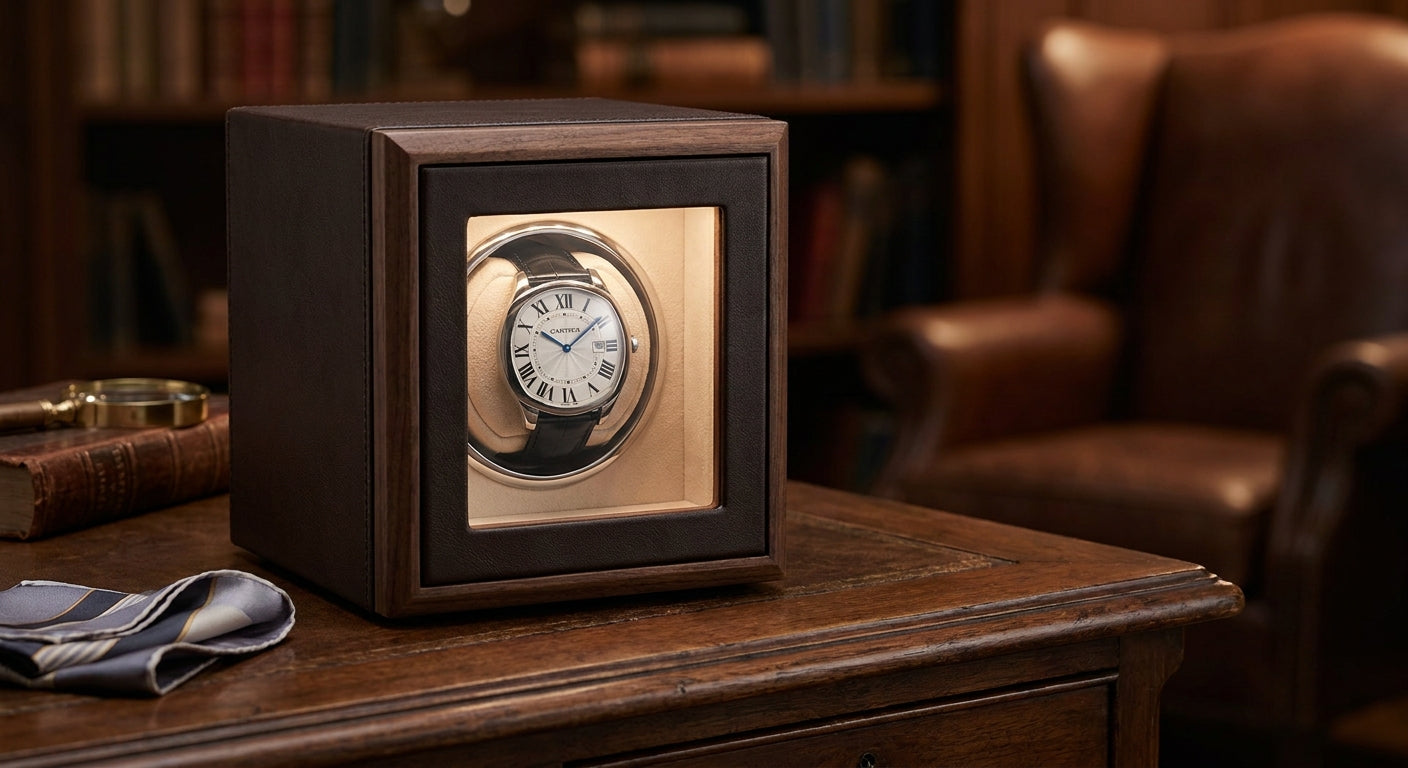
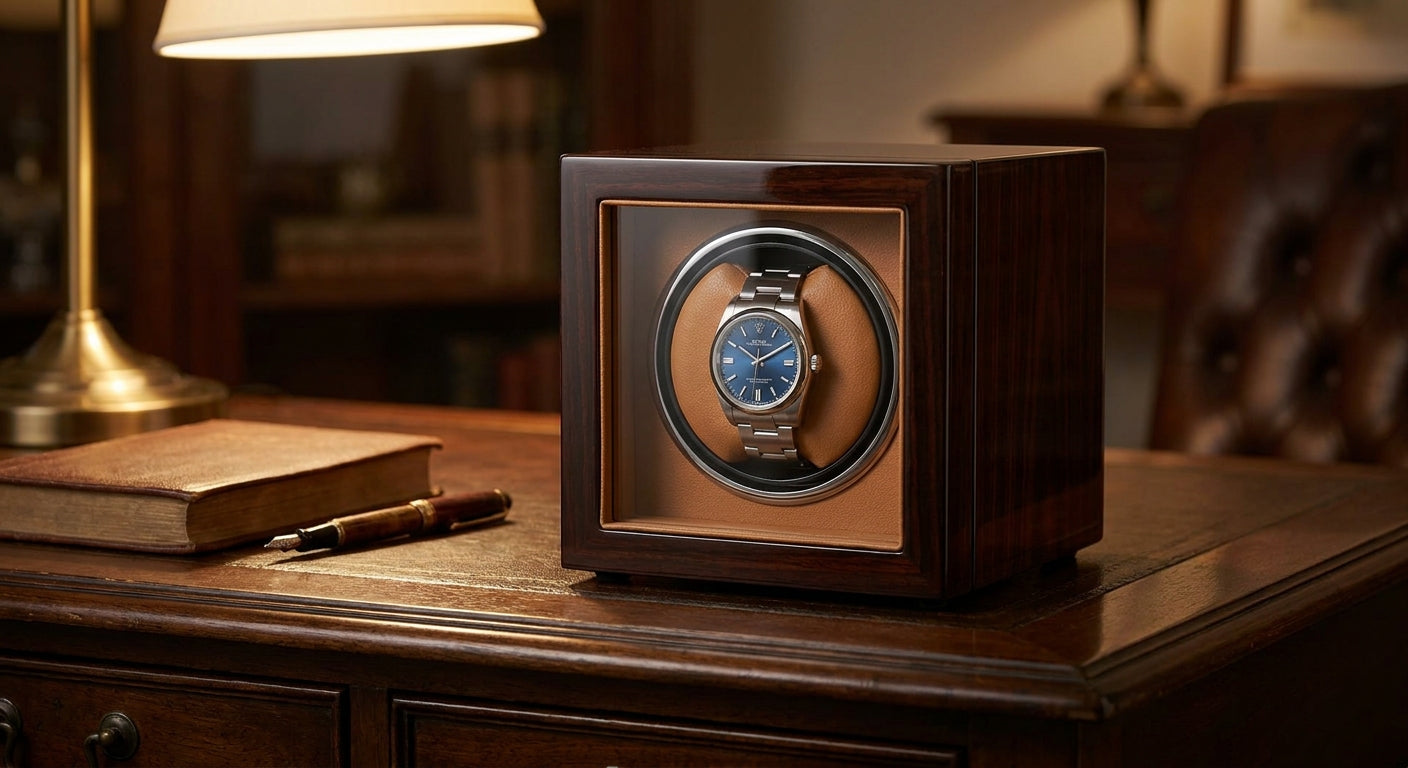
Impresario Series 2 Watch Winder — the safe pick. Two rotors, independent programs, fingerprint access, and a telescopic pillow that runs 36mm to 55mm — wide enough for a 38mm Annual Calendar case and a 41mm reference without swapping cushions. At $649, it's built for exactly one Annual Calendar plus a rotation piece, nothing more. Verdict: Buy for a single Annual Calendar with one backup watch. Impresario Series 2 watch winder
Virtuoso Series 2 Watch Winder — the budget-precise pick. Same independent-TPD architecture as the Impresario line at $599, minus the fingerprint lock — a fit for an Annual Calendar already sitting inside a safe or locked cabinet where the winder doesn't need its own security layer. Two rotors, each dialed to its own watch's spec, run without the premium biometric access adds elsewhere in the lineup. Verdict: Consider if the winder lives inside existing secure storage. Virtuoso Series 2 watch winder
Yachtline Series 8 Watch Winder — the consolidator. Eight rotors laid flat across a low cabinet at $1,399, biometric access, and enough independent programs to run an Annual Calendar next to seven other automatics without a shared TPD compromise. This is the point where a single- or double-slot winder stops making sense and a horizontal 8-slot unit takes over. Verdict: Buy once the collection passes four or five pieces; Skip for one watch. Yachtline Series 8 watch winder
What to avoid
- Fixed single-direction winders under roughly $200 — they undercharge a bidirectional rotor by half the wind cycles the movement needs.
- Winders with one shared TPD across all slots — fine for a single-caliber collection, wrong the moment an Annual Calendar sits next to a Rolex or Omega with a different spec.
- Twelve-slot or larger winders for a one- or two-watch collection — in 2026 those run $1,499 and up, and the extra rotors sit empty while the security case built for a dozen pieces is oversized for one.
Verdict comparison
| Winder | Rotors | TPD control | Lock | Price | Verdict |
|---|---|---|---|---|---|
| Impresario Series 2 | 2 | Independent, adjustable | Biometric | $649 | Buy |
| Virtuoso Series 2 | 2 | Independent, adjustable | None | $599 | Consider |
| Yachtline Series 8 | 8 | Independent, adjustable | Biometric | $1,399 | Buy (4+ watches) |
FAQ
What's the best watch winder for a Patek Philippe Annual Calendar?
The Impresario Series 2 Watch Winder is the best fit for a single Annual Calendar at $649, since it runs bidirectional, adjustable TPD through independent programs per rotor. Larger collections move up to an 8-slot unit like the Yachtline Series 8 once a third or fourth automatic joins the rotation.
Does a Patek Philippe Annual Calendar need bidirectional winding?
Yes, caliber 324 S QA and its Annual Calendar successors use a bidirectional rotor, and a single-direction winder only engages half the winding cycles. Confirm bidirectional capability on the spec sheet before buying, since it can't be adjusted after purchase.
How many TPD does a Patek Philippe Annual Calendar need?
Patek's automatic movements generally call for 800 to 950 turns per day. A fixed-TPD winder outside that band either under-winds the mainspring over weeks or runs the rotor at a rate the movement doesn't need.
Can one watch winder run a Patek Philippe Annual Calendar and a Rolex together?
Yes, as long as the winder offers independent programming per slot rather than one shared TPD setting. A Rolex and a Patek Annual Calendar rarely share the same TPD requirement, so a shared-setting winder forces a compromise number for both.
Is a fixed-TPD watch winder bad for a Patek Philippe Annual Calendar?
It's a mismatch, not a disaster, but it leaves the mainspring either under- or over-charged relative to the 800 to 950 TPD range Patek's automatic calibers are built around. Over months, that mismatch shows up as inconsistent power reserve when the watch comes off the winder.
How much does a good watch winder for a Patek Philippe cost in 2026?
A single- or double-slot winder built for a bidirectional, adjustable-TPD movement runs $599 to $649 in 2026, with biometric-locked and larger multi-slot units running $1,399 to $1,499 and up. Price scales with rotor count and lock type, not with brand name alone.
What happens if a Patek Philippe Annual Calendar fully stops?
The day, date, month, and moon-phase indications all drift or freeze, and getting them back requires resetting each corrector by hand, sometimes in a specific sequence. A properly configured watch winder keeps the mainspring charged so that reset never becomes necessary.
Does an Annual Calendar need a bigger cushion than a three-hand watch?
Not necessarily bigger, but it needs an adjustable one. Annual Calendar cases range from 38mm to 41mm depending on the reference, and a fixed cushion sized for one case diameter will pinch or under-hold the other.
One last thing
The Annual Calendar mechanism is built to track months of 30 and 31 days automatically — the one manual correction it still needs happens once a year, at the transition into February, and no winder changes that. What a watch winder for a Patek Philippe Annual Calendar actually buys you is avoiding the other 364 days of resets: the day, date, and moon-phase drift that follows a full stop, not the single yearly correction Patek built the movement to require anyway. Enigwatch's 2026 winder lineup is built around that distinction — adjustable TPD and bidirectional rotors that keep the mainspring charged, not a workaround for the one correction the caliber was designed to need.
Related guides
Protect Your Watch Collection
Designed for collectors who demand the best. Explore our premium watch winders and luxury safes.