Chopard L.U.C automatics run on an in-house micro-rotor system built for smooth, low-torque winding — get the TPD and direction wrong and you're either under-winding a Geneva Seal movement or grinding the rotor against a mechanism that never needed the extra push.
- The best watch winder for Chopard L.U.C runs bidirectional at 650-950 TPD; Virtuoso Series 2 is the safe buy at $599.
- Impresario Series 2 adds fingerprint access for two L.U.C pieces at $649 — a Consider if biometric security matters to you.
- Skip single-direction winders under 500 TPD; Chopard's micro-rotor calibers stall on too-low turn counts.
- Yachtline Series 8 handles eight-piece rotations at $1,399 for collectors mixing L.U.C with other in-house calibers.
Why this matters
Chopard's L.U.C calibers — the 96.01-L, the 1.96, the 4.96 — carry the Poinçon de Genève and run on a micro-rotor architecture that winds in both directions with less torque than a full-rotor movement. Put that movement in a winder built for a heavier automatic and you're either overworking a barrel that doesn't need it or leaving the mainspring under-tensioned.
If you've already looked at Enigwatch's Chopard automatic watch winder options and want the settings locked in for the L.U.C line specifically, this breaks down TPD, direction, and which winder body actually fits a one-to-eight-piece L.U.C collection in 2026.
Who this is for
This is written for the owner of at least one in-house Chopard L.U.C automatic — the kind of piece that sat in a display case before it sat on a wrist — often paired with other Genève-certified or in-house calibers from Vacheron, JLC, or Patek. If you're storing one L.U.C or rotating eight watches through a weekly routine, the settings below and the winder picks that follow are built around that exact profile, not a generic automatic.
What to look for in a watch winder for Chopard L.U.C
Bidirectional rotation
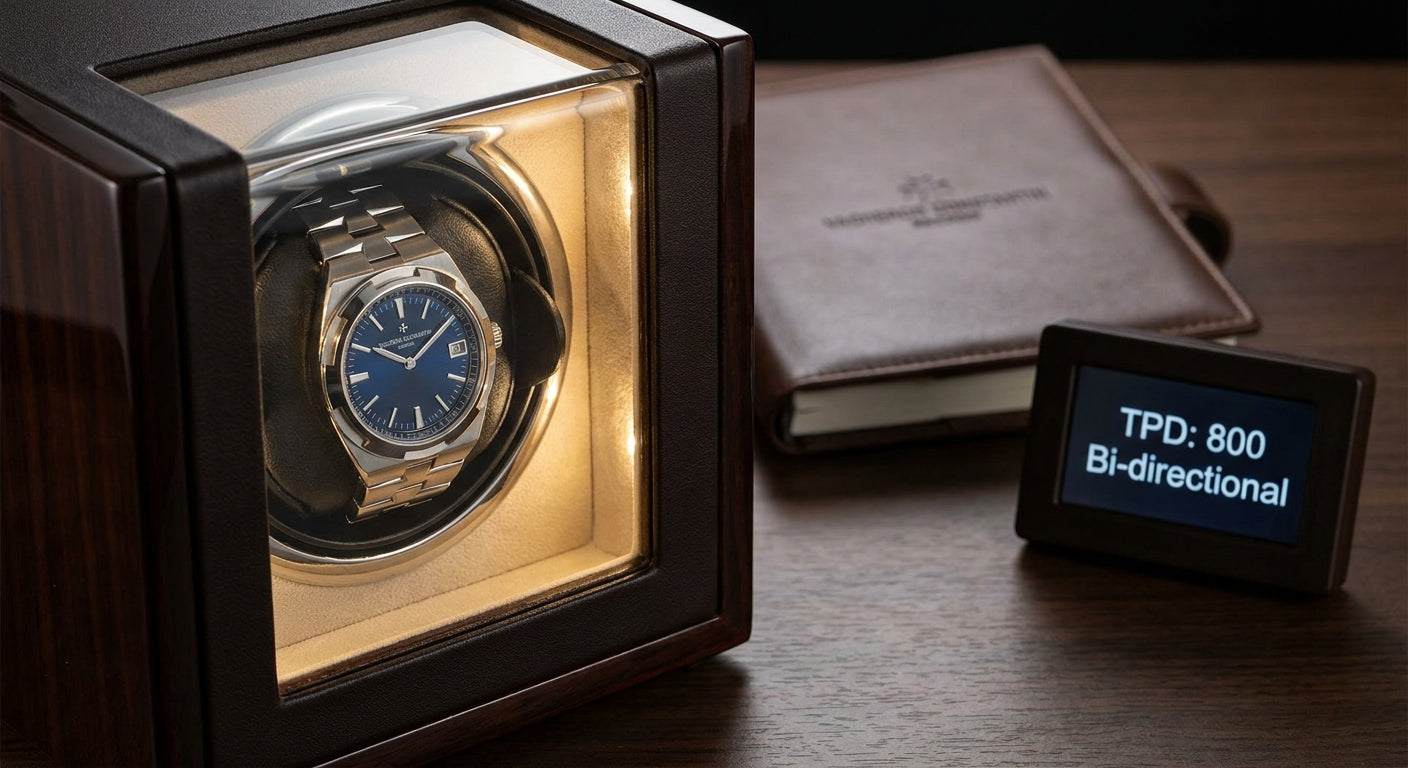
Chopard's micro-rotor system winds the mainspring in both clockwise and counterclockwise motion by design. A single-direction winder forces the escapement to work against its own construction on every cycle, and over a few years that shows up as premature wear in the keyless works. Bidirectional is not optional here — it's the baseline requirement.
TPD in the 650-950 range
Most L.U.C automatics settle comfortably between 650 and 950 turns per day. Go lower and the barrel never reaches full tension between wearings; go higher and you're adding unnecessary cycles to a movement that Chopard already tuned for efficiency. Treat 800 TPD as the default starting point and adjust from there.
Cushion size matched to a slim case
L.U.C cases run 38mm to 40mm on most references — smaller and thinner than a modern dive watch. A winder built around oversized 46mm cushions leaves the watch loose in the strap cradle, which means rattling and uneven winding contact overnight. Telescopic, adjustable pillows matter more here than they would for a chunkier sports piece.
Quiet motor operation
A winder that lives on a nightstand or in a bedroom closet needs a motor you can't hear from six feet away. Mabuchi motors, the type Enigwatch runs across its winder line, are built for this kind of low-noise continuous cycling rather than the louder gear-driven motors found in budget boxes.
Independent programs for mixed collections
If the L.U.C sits next to a Rolex, an Omega, or a second Chopard reference with a different power reserve, one shared TPD setting across every slot is a compromise for at least one watch. A winder with independent per-slot programming lets the L.U.C run at 800 TPD while a neighboring caliber runs at 650 or 950 without touching the same dial.


Top picks for a Chopard L.U.C collection
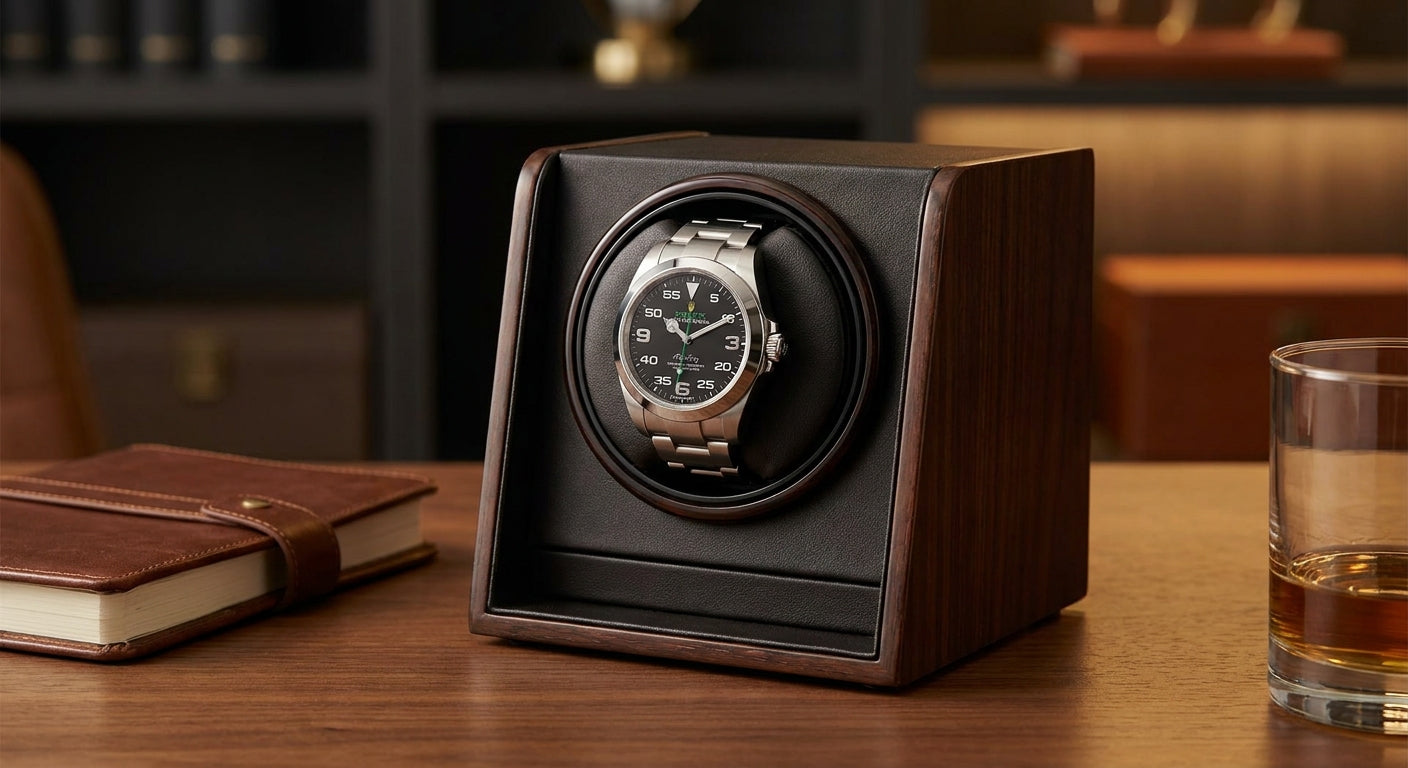
Virtuoso Series 2 Watch Winder — the safe pick. Two rotors, each on its own independent program, finished in Macassar Ebony with Alcantara lining. At $599 it covers a single L.U.C plus a second in-house piece without forcing a shared setting on either watch. Buy.
Impresario Series 2 Watch Winder — the biometric wildcard. Fingerprint access, two independent rotor programs, Macassar Ebony exterior. At $649 the fingerprint lock is the only real difference from the Virtuoso 2, so it's worth the extra $50 if the winder sits somewhere shared with household staff or guests. Consider.
Yachtline Series 8 Watch Winder — the collector's spread. Eight rotors arranged horizontally like a display tray, biometric access, priced at $1,399. This is the pick once an L.U.C sits alongside seven other automatics rotating through weekly wear. Buy for anyone past a four-piece collection.
Watch Winders Pillow — the accessory fix. A telescopic pillow adjusting from 36mm to 55mm, priced at $59, solves the loose-cushion problem on any existing winder built for larger cases. It won't fix a single-direction motor, but it fixes fit. Consider as an add-on, not a standalone solution.
What to avoid
- Single-direction box winders under $150. Marketed as fitting "any automatic," most run one direction at a fixed 400-500 TPD — too low for an L.U.C micro-rotor and mechanically wrong for the winding system.
- Oversized 46mm+ fixed cushions. Built for dive watches and chronographs, these leave a 38-40mm L.U.C case loose enough to rattle against the cradle overnight.
- Open-tray winders with no lock. Fine for a $400 automatic, not appropriate once the collection includes a Geneva-certified piece worth five figures or more.
Verdict comparison
| Pick | Direction | TPD range | Price | Best for | Verdict |
|---|---|---|---|---|---|
| Virtuoso Series 2 | Bidirectional | 650-950 | $599 | Single L.U.C or a pair | Buy |
| Impresario Series 2 | Bidirectional | 650-950 | $649 | Shared household access | Consider |
| Yachtline Series 8 | Bidirectional | 650-950 | $1,399 | Four-plus rotating collection | Buy |
FAQ
What's the best watch winder for a Chopard L.U.C?
The Virtuoso Series 2 at $599 is the best watch winder for a Chopard L.U.C for most single or two-piece owners because it runs bidirectional at an adjustable TPD without oversized cushions. Collectors rotating four or more watches should look at the Yachtline Series 8 instead.
Should a Chopard L.U.C winder run bidirectional or single-direction?
Bidirectional, without exception. Chopard's L.U.C micro-rotor calibers wind in both directions by design, and a single-direction winder forces the escapement against its own construction on every cycle.
How many TPD does a Chopard L.U.C need?
Most L.U.C automatics settle between 650 and 950 turns per day, with 800 TPD as a reasonable default starting point. Adjust up or down based on how consistently the barrel holds tension over a week off the wrist.
Can one winder handle a Chopard L.U.C paired with a Rolex or Omega?
Yes, as long as the winder runs independent programs per slot. A shared single TPD setting across every rotor forces at least one caliber into the wrong range.
Is a biometric watch winder worth it for Chopard L.U.C?
It's worth the upgrade if the winder sits somewhere other people access, like a shared closet or office. For a private nightstand, a standard lock-free model like the Virtuoso Series 2 does the same mechanical job for less.
How much does a good watch winder for Chopard L.U.C cost in 2026?
Compatible winders in 2026 range from about $599 for a two-slot model to $1,499 for a twelve-slot biometric unit. Price scales with slot count and lock hardware, not with winding quality.
Does an L.U.C 1.96 need a different TPD than an L.U.C 96.01-L?
Both calibers fall within the same 650-950 TPD window since they share the same micro-rotor winding logic. Fine-tune within that range based on how the individual watch holds power reserve over a few days of rest.
Will a watch winder damage a Chopard L.U.C movement?
Not at the correct bidirectional setting within 650-950 TPD. Damage risk comes from mismatched winders — single-direction motors or TPD settings far outside that range — not from winding an automatic in general.
One last thing
Chopard rarely publishes an exact TPD figure for the L.U.C line the way some brands do for a single reference — most of what collectors use comes from testing within the 650-950 window and watching how the power reserve holds. If a piece is still under warranty, start at the low end of that range; a Geneva Seal movement is finished to a tolerance that a slightly conservative TPD setting won't undercut, and it's easier to add turns later than to walk back wear.
Related guides
Protect Your Watch Collection
Designed for collectors who demand the best. Explore our premium watch winders and luxury safes.