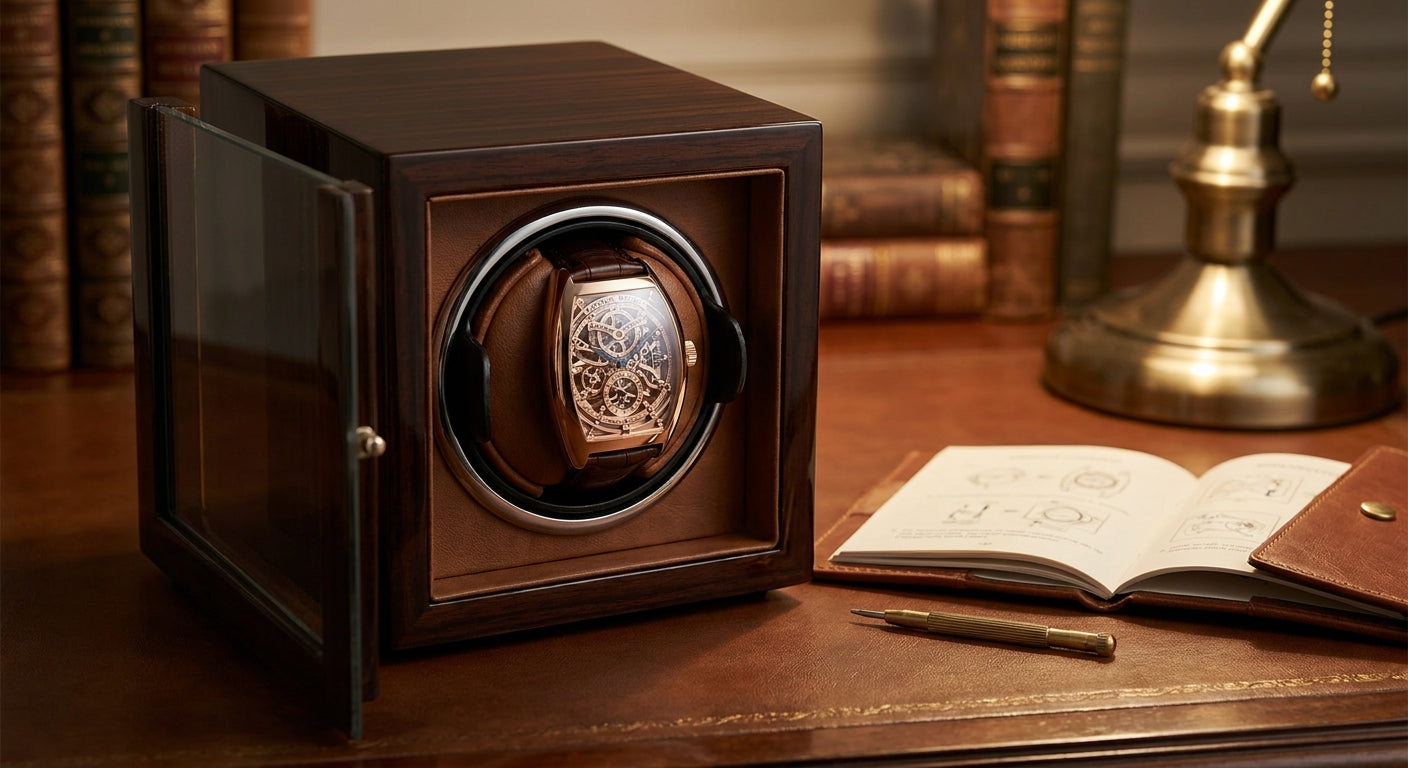
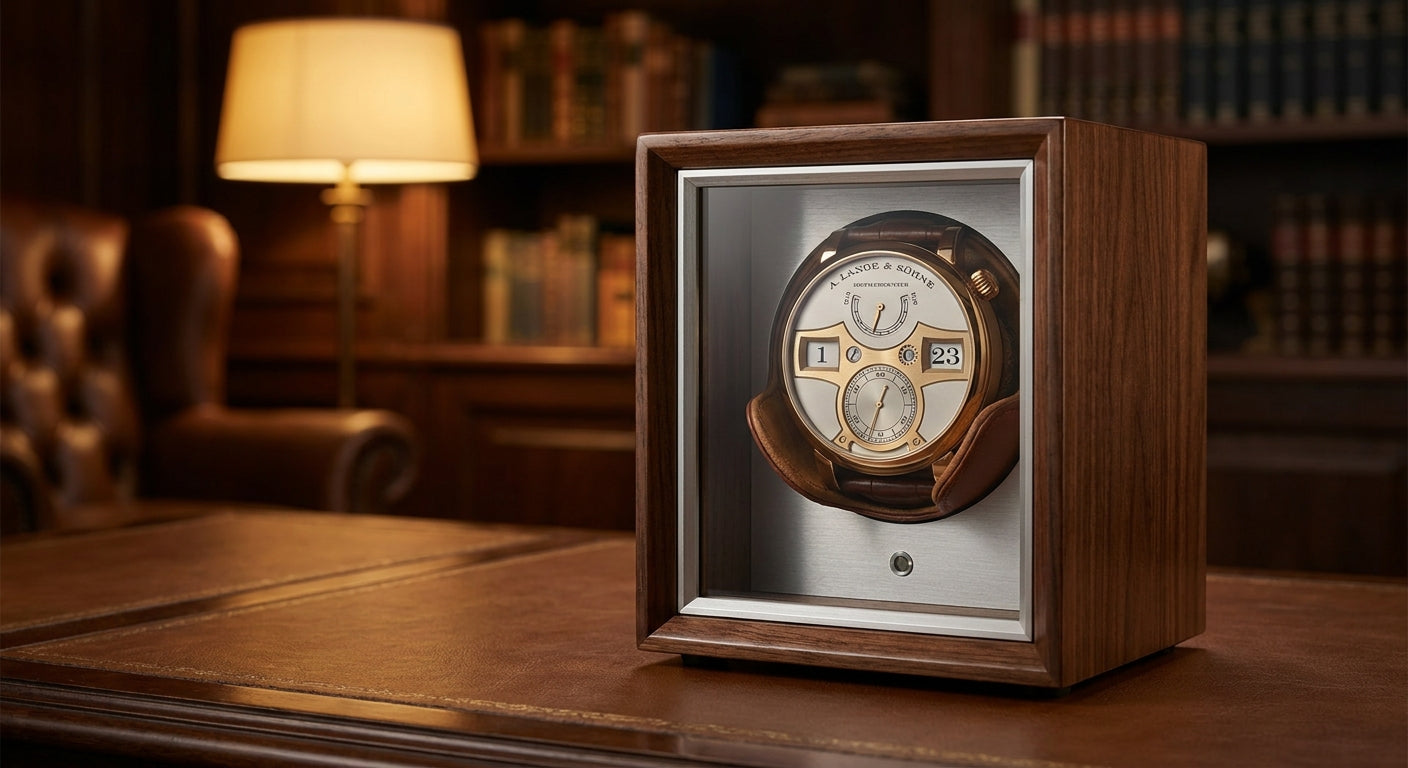
A Parmigiani Fleurier on the wrist deserves a winder that matches the engineering inside the case, not a generic box with a motor bolted in. This guide covers the TPD range, rotor direction, and build criteria that actually matter for Tonda, Toric, and Kalpa owners, plus which Enigwatch models are worth the money in 2026.
TL;DR
For a watch winder for Parmigiani Fleurier pieces, set 650-900 TPD with bidirectional rotation as the default, since most Parmigiani in-house calibers use micro-rotor or peripheral-rotor construction that doesn't favor one direction. The Virtuoso Series 2 Watch Winder is the Buy for a single Tonda plus a companion piece, and the Impresario Series 6 Watch Winder is the Buy for a growing collection of four to six automatics. Skip cheap 1,200+ TPD winders — they over-wind delicate barrels and shorten mainspring life. A watch this precise gets stored, not gambled with.
Why this matters
Parmigiani Fleurier builds its own movements in-house, and several use micro-rotor or peripheral-rotor architecture instead of the full oscillating mass found in mass-market automatics. That changes how the caliber winds, how much torque it needs from an external motor, and how forgiving it is of the wrong TPD setting.
Get the direction or turn count wrong for months and you're not damaging the watch outright — you're accelerating wear on a mainspring barrel that costs real money to service. A watch winder for Parmigiani Fleurier needs to be dialed in correctly from day one, not left on factory defaults built for a generic Swiss automatic.
Who this is for
This guide is for owners of a Tonda PF, Toric, or Kalpa who rotate the piece off-wrist for days or weeks at a time and want the mainspring at proper tension when they put it back on. It's also for collectors adding a Parmigiani to a mixed case that already holds Rolex, Patek Philippe, or Audemars Piguet pieces, where TPD settings need to work across brands without babysitting each watch individually.
What to look for in a watch winder for Parmigiani Fleurier
Bidirectional rotation as the default
Most Parmigiani Fleurier in-house calibers wind in both directions or favor a lighter touch than a heavy full-rotor movement needs. A winder locked to clockwise-only forces the mechanism to work against its own design on half its cycles. Look for a motor program that offers bidirectional (CW/CCW) settings, not just a single fixed direction.
TPD range between 650 and 900
Too few turns per day and the mainspring never reaches full tension, so the watch runs down between wears. Too many turns — anything north of 1,200 TPD — over-tensions a delicate barrel over months of continuous storage. A winder with adjustable TPD in the 650-900 window covers the vast majority of Parmigiani Fleurier automatics without guesswork.
Quiet, low-vibration motor
A Japanese Mabuchi motor turning at low RPM produces a fraction of the vibration of a cheap stepper motor cycling constantly to hit its TPD count. Vibration transfers into the movement over weeks, and a high-end caliber with fine finishing doesn't need that kind of wear. If the winder is going on a nightstand or bedroom dresser, motor noise and vibration matter as much as the TPD number itself.
Insert size and cushion fit for Tonda and Kalpa cases
Parmigiani cases run from the slim Tonda profile to the larger Kalpa shapes, and a cushion built for a generic 42mm round case can leave gaps that let the watch shift during rotation. Check the insert diameter and depth against the specific case before buying — a loose fit means the watch bounces instead of winding cleanly.
Security and humidity control for the storage box
A piece in this price range sitting in a drawer isn't really stored, it's exposed. Biometric or combination access, plus humidity-stable interior lining, protects both the movement and the resale value over years of ownership, and it matters more the longer the watch sits between wears.
Top picks for a Parmigiani Fleurier collection
The quiet pairing pick — Virtuoso Series 2 Watch Winder. Two independently programmable modules cover a Tonda plus a daily-wear piece, each set to its own TPD and direction. Alcantara-lined cushions fit slim and mid-size cases without gapping, and the Mabuchi motor runs quiet enough for a bedroom setup. Verdict: Buy for a two-watch rotation that includes one Parmigiani.
The collector's core — Impresario Series 6 Watch Winder. Six independent modules with full TPD and direction control per slot handle a Parmigiani alongside five other automatics without forcing a single setting across the whole box. This is the unit most Parmigiani owners with a growing collection actually land on by 2026, because it scales without demanding a second purchase in a year. Verdict: Buy for a four-to-six-piece rotation.
The vault-ready option — Virtuoso Series 12 Watch Winder. Twelve modules and a locking door suit a collector who has built past a handful of pieces and wants winding and secure storage in one footprint. It is more box than most single-Parmigiani owners need today, so it is a Consider rather than an outright Buy unless the collection already justifies a 12-slot unit.
The security layer — Apollo Watch Safe Box. For pieces not currently in rotation, a dedicated safe with biometric access and a humidity-stable interior protects the ones sitting idle between wind cycles. Pairing a winder for active pieces with a separate safe for the rest is standard practice among serious collectors. Verdict: Buy as a second purchase alongside a winder, not instead of one.
What to avoid
- Single fixed-direction winders under $200. They look like a bargain but force a bidirectional-friendly caliber to wind against its natural rotor path half the time.
- Winders advertised at 1,200+ TPD with no adjustment. That figure is built for a small handful of high-beat movements, not a Parmigiani Fleurier automatic, and it over-tensions the barrel over months of continuous use.
- Foam or generic velvet cushions instead of a fitted insert. A Kalpa's rectangular case or a slim Tonda profile shifts inside a cushion built for a standard round case, which means uneven winding and cosmetic wear on the caseback over time.
Verdict comparison
| Model | TPD range | Direction control | Modules | Verdict |
|---|---|---|---|---|
| Virtuoso Series 2 Watch Winder | Adjustable, per module | Bidirectional | 2 | Buy — single Parmigiani plus one daily piece |
| Impresario Series 6 Watch Winder | Adjustable, per module | Bidirectional | 6 | Buy — growing 4-6 piece rotation |
| Virtuoso Series 12 Watch Winder | Adjustable, per module | Bidirectional | 12 | Consider — only for larger established collections |
| Apollo Watch Safe Box | N/A (storage, no winding) | N/A | 12 slots | Buy — companion to a winder, not a replacement |
FAQ
What TPD should I use for a Parmigiani Fleurier? Set 650-900 TPD with bidirectional rotation as the starting point in 2026, then check power reserve after a week and adjust up or down within that range if the watch runs down or feels over-wound.
Does a Parmigiani Fleurier need a bidirectional winder? Yes, in most cases — several in-house calibers use micro-rotor or peripheral-rotor construction that doesn't strongly favor a single winding direction, so a bidirectional program covers the mechanism better than a fixed clockwise-only setting.
Can I use the same winder for Parmigiani and Rolex pieces? Yes, as long as the unit has independently programmable modules — a shared winder with a single fixed TPD across all slots will be wrong for at least one of the two calibers.
How much does a good watch winder cost in 2026? A winder built for a collection that includes a Parmigiani Fleurier typically starts in the low thousands and rises with module count and material — Alcantara-lined multi-module units sit well above entry-level plastic boxes.
Is a safe or a winder more important for a Parmigiani Fleurier? Both serve different jobs — a winder keeps an active piece wound and ready to wear, while a safe protects pieces not currently in rotation from humidity, dust, and unauthorized access.
Will a winder damage my Parmigiani Fleurier if the TPD is wrong? Not immediately, but running a delicate barrel at the wrong tension for months accelerates mainspring wear, which shows up as service costs down the line rather than sudden failure.
How many modules do I need for one Parmigiani and a small rotation? Two modules cover a Parmigiani plus one other piece; four to six modules make sense once the collection grows past a pair of automatics that need independent settings.
Do I need a humidity-controlled box for a Parmigiani Fleurier? It is not mandatory but it is good practice — a stable interior environment protects both the case finish and the movement over years of storage, especially in climates with seasonal humidity swings.
One last thing
Most owners set TPD once at purchase and never revisit it, but a Parmigiani Fleurier's power reserve is worth checking again after the first month on a new winder — if it is running long past full charge, the TPD is set higher than the caliber needs, and dialing it back by 100-150 turns extends barrel life without any loss in reliability.
Related guides
Protect Your Watch Collection
Designed for collectors who demand the best. Explore our premium watch winders and luxury safes.