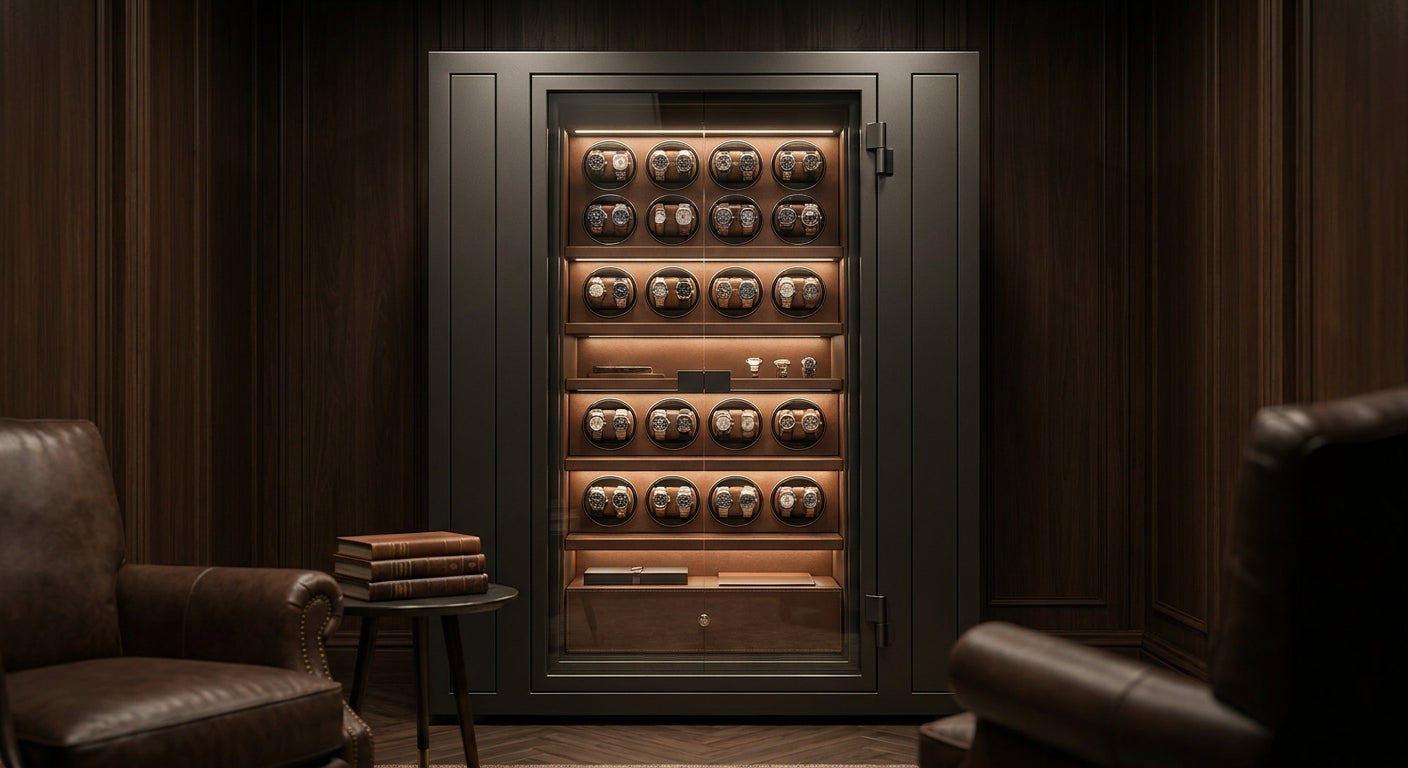
Door thickness is the single number safe sellers throw around most and explain least — and it tells you almost nothing on its own without the steel grade and lock mechanism behind it.
TL;DR
Watch safe door thickness matters less than the composite of steel gauge, bolt count, and UL burglary rating stamped on the door — a 3/8-inch composite door with a UL TL-15 rating stops a determined break-in far longer than a solid 3/4-inch door with no independent rating at all. For a 12- to 20-piece collection, look for doors rated to resist at least 15 minutes of tool attack, not just a thick-sounding spec sheet number. The Centennial Bulletproof Watch Safe Box is a Buy for collectors who want documented ballistic and burglary testing behind the door, not just mass. Verdict: thickness alone is a marketing number in 2026 — the rating behind it is the real spec.
Why this matters
Most watch safe listings advertise a door thickness — half inch, three-quarter inch, sometimes a full inch — as if raw steel depth were the whole story. It isn't. A thick door made from low-grade cold-rolled steel with two locking bolts fails faster against an angle grinder than a thinner, hardened composite door with active relockers and eight bolts.
Collectors storing a Rolex, Patek Philippe, or Audemars Piguet at home are protecting pieces that can individually exceed the cost of the safe itself. The Centennial Bulletproof Watch Safe Box exists because Enigwatch treats the door assembly as a system — steel composition, bolt work, and lock — not a single thickness figure on a spec sheet. Get the door assessment wrong in 2026 and the rest of the safe's features (biometric access, Alcantara lining, climate control) are protecting a box that opens in under ten minutes with the right tool.
What you'll need
- A tape measure or calipers for verifying actual door thickness (not just trusting the listing)
- The safe's UL rating documentation, if one exists (TL-15, TL-30, RSC, or none)
- Knowledge of your collection's total insured value, since door spec should scale with what's inside
- A list of the attack methods common in your area — pry bar, grinder, drill — from a locksmith or insurer if available
- Access to the safe's spec sheet showing steel gauge, bolt count, and lock type
- A reference safe like the Titan Sanctum 20 Watch Safe Box to compare door construction claims against
The steps
1. Measure the door, not the body
Sellers often quote overall wall thickness of the safe body, which can be thinner than the door by half or more. Confirm the door spec separately — a body listed at half an inch can ship with a door at three-eighths of an inch or less.
Use calipers on a showroom unit or request the door-specific spec sheet before buying. Common mistake: assuming the advertised thickness applies uniformly to every panel of the safe.
2. Check for an independent burglary rating
A UL TL-15 rating means the door resisted a battery of tools for 15 minutes in lab testing; TL-30 extends that to 30 minutes against a broader tool set including torches. Neither rating exists without third-party testing — a safe with no rating and a thick door is an unverified claim, not a fact.
Ask directly whether the door assembly carries a rating or just a manufacturer's internal estimate. Common mistake: confusing a fire rating (temperature and duration) with a burglary rating (tool resistance) — they measure completely different threats.
3. Count the locking bolts
Door thickness resists cutting and drilling; bolt count and placement resist prying. A door with four bolts on one side flexes under a pry bar differently than one with bolts on all four edges, sometimes eight or more.
Look for bolt diameter as well as count — thin bolts on a thick door is a mismatched design. Common mistake: buying based on door thickness while ignoring that the bolts are the actual failure point in most forced-entry attempts.
4. Verify the hinge side is protected
A thick door with exposed external hinges can be knocked off with a hammer and chisel in under two minutes, regardless of door depth. Internal or protected hinges, plus interlocking door lips, close this gap.
Inspect whether the hinge pins are accessible from outside the safe when the door is closed. Common mistake: overlooking hinge design because attention is fixed entirely on the headline thickness number.
5. Match the door spec to your collection's value tier
A single dress watch under $5,000 does not need the same door assembly as a 12-piece collection running into six figures. Scale the spec: for higher-value collections, prioritize a documented rating over a marketing thickness claim.
Cross-reference against a model built for larger collections, such as the Titan Sanctum 20 Watch Safe Box, to see how door spec typically scales with slot count. Common mistake: buying the thickest door available regardless of what it's actually protecting.
6. Confirm the lock type behind the door
Door thickness is irrelevant if the lock itself is the weak point — a basic key lock is manipulable in ways a certified biometric or electronic lock is not. The door and the lock have to be evaluated as one system.
Check whether the lock has its own certification separate from the door's steel rating. Common mistake: treating the door and the lock as independent purchase decisions when they function as a single security layer.
Troubleshooting
- The spec sheet lists thickness but no UL rating — treat the thickness number as unverified and ask the seller directly whether third-party testing exists.
- Door thickness differs between the listing and the physical unit — request a written spec confirmation before final purchase, especially on custom orders.
- The safe has a thick door but external hinges — this is a real vulnerability regardless of steel depth; ask about hinge protection specifically.
- Bolt count isn't listed anywhere — this is a red flag on any safe over $2,000; a legitimate manufacturer publishes bolt specs alongside door thickness.
- The safe passed a fire rating but has no burglary rating — these are separate certifications; a safe can be excellent against fire and mediocre against forced entry.
- You're comparing safes across brands with different thickness units — normalize everything to inches or millimeters before comparing, since some listings mix gauge numbers with raw measurements.
Tools and resources
- Watch safe fire rating: what the numbers actually mean for separating fire resistance from burglary resistance
- Watch safe with steel body for luxury timepieces for a deeper look at steel grade beyond thickness alone
- How to bolt down a watch safe at home since anchoring matters as much as door spec once the safe is installed
- Calipers or a tape measure for on-site verification
- Your homeowner's insurance policy, which often specifies minimum safe ratings for full coverage on watch collections
What to do next
Once the door spec checks out, the next decision is whether the rest of the safe matches — interior layout, humidity control, and slot count for your specific collection size. Use the door construction of a benchmark model as your reference point before finalizing a purchase in 2026.
FAQ
What is a good door thickness for a watch safe? There's no single good number without context — a 3/8-inch composite door with a UL TL-15 rating outperforms a 3/4-inch door with no independent testing. Match the spec to your collection's value, not the raw inches.
Is a thicker door always more secure? No. Thickness resists drilling and cutting, but bolt count, hinge protection, and lock type determine how the door performs under a pry attack. A thick door with weak bolts still fails quickly.
What does a UL TL-15 rating mean? It means the door and lock assembly resisted a specific set of tools for 15 minutes under independent lab testing. TL-30 extends resistance to 30 minutes against a wider tool set including torches.
How much does a high-security watch safe cost in 2026? Prices for safes with documented burglary and fire ratings generally start in the mid-thousands and run well past $20,000 depending on interior features, size, and lock type.
Does door thickness affect fire protection too? Partially — thicker doors slow heat transfer, but fire rating depends more on insulation material and door seal quality than raw steel depth alone.
Can I retrofit a thin-door safe with better security? Not meaningfully. Door assemblies are engineered as a unit; aftermarket reinforcement rarely restores the integrity of a properly rated door and can void a warranty.
Should I prioritize thickness or bolt count when comparing safes? Bolt count and placement first, then thickness. A well-bolted door at a moderate thickness typically outperforms a thick door with minimal bolt work.
Is a home safe with a thick door enough, or do I need it bolted to the wall? Thickness alone doesn't stop a safe from being carried out. Anchoring the unit is a separate and necessary step regardless of door spec.
One last thing
The detail most buyers miss in 2026: manufacturers are not required to disclose whether a listed thickness includes composite fill or is solid steel end to end. Ask for the material breakdown behind the number before you compare two safes on thickness alone — the spec sheet rarely volunteers it.
Related guides
Protect Your Watch Collection
Designed for collectors who demand the best. Explore our premium watch winders and luxury safes.