A watch safe interior is either built around cushion trays that cradle each case individually or drawer trays that stack pieces flat under a lid — and the choice changes how many watches fit, how they wear over years of storage, and how easy the safe is to load. This guide breaks down both layouts so you pick the right one for your collection size and case types.
TL;DR
Cushion trays hold cases upright on individual pillows, which protects large or oddly shaped cases (chronographs, dive watches with 44mm+ diameters) from touching each other. Drawer trays lay watches flat in slotted rows, packing more pieces into less vertical space — useful for collections of 12 or more. For a mixed collection of Rolex, Patek Philippe, and modern chronographs, a hybrid layout with cushion trays on top and a flat drawer below is the Buy. A safe with drawer-only layout and no bezel clearance for oversized cases is a Skip for anyone collecting dive or pilot watches. The Veron 20 watch safe box uses this hybrid approach across its 20 slots.
Why this matters
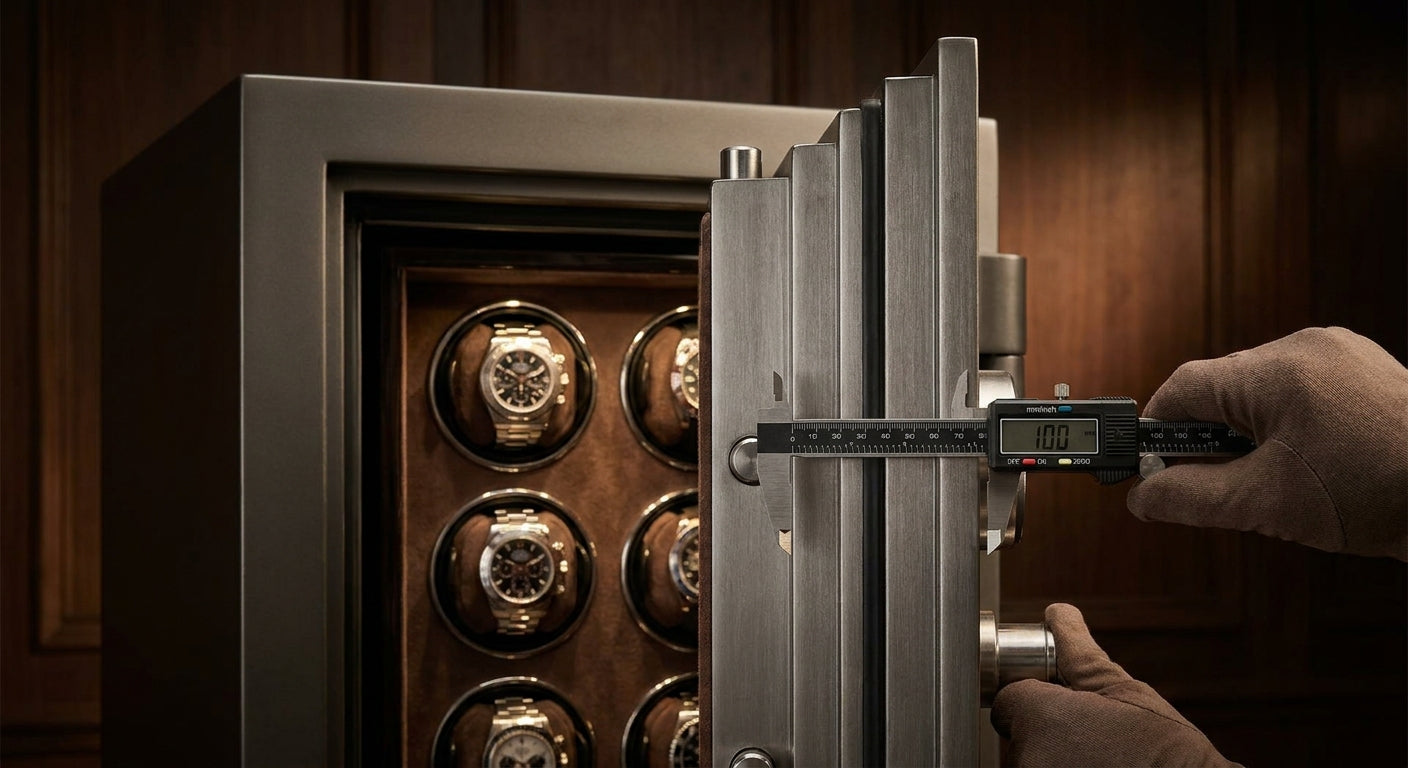
A watch safe interior layout decides three things collectors underestimate before buying: how much bezel clearance each slot has, how the leather or Alcantara lining wears against the case back, and how fast you can grab a specific watch without disturbing five others. A 44mm dive watch with a rotating bezel does not sit the same way in a 20mm-tall drawer slot as a 36mm dress watch. Get the layout wrong and you end up cramming cases sideways, scuffing crowns against neighboring slots, or storing half the collection in the original boxes because the safe ran out of usable depth.
Most watch safes sold in 2026 advertise slot count without specifying tray depth or cushion diameter, which is the number that actually determines fit. A 20-slot safe with 28mm cushions works for vintage dress pieces and fails immediately on a modern 42mm sport watch.
What you'll need
- A tape measure and your watch case diameters (lug to lug, not just dial width)
- A list of which watches need winding versus static storage
- Knowledge of your safe's interior height per tray (measured in millimeters, not just "fits 12 watches")
- A soft cloth for handling cases during the layout process
- Roughly 30-45 minutes for a full reorganization of a 12-20 watch collection
The steps
1. Measure every case before you plan a single slot
Grab the diameter and case-back height of every watch going into the safe. A collection running from a 36mm Cartier Tank to a 45mm Panerai Luminor cannot use identical cushions — the small cases will slide and the large ones will overhang. Write the measurements down; guessing from memory is the most common reason collectors buy a safe that's one size too small.
Common mistake: assuming "fits 20 watches" means 20 watches of any size. Manufacturers spec that number against a standard 40mm case.
2. Decide cushion vs drawer based on case height, not just count
Cushion trays raise each watch on a pillow, which adds roughly 15-25mm of vertical clearance per tier but protects tall case backs and chunky bracelets from crushing against the tray above. Drawer trays lay watches flat in a slotted foam or leather bed, which is more space-efficient for thin dress watches but risks pressure marks on cases taller than 13mm.
If your collection leans toward chronographs and dive watches, cushion trays win. If it's mostly slim automatics under 40mm, drawer trays fit more pieces per cubic foot of safe interior.
3. Match the interior lining to your climate
Alcantara absorbs moisture better than smooth Nappa leather and resists case-back scratching on textured backs, which matters in humid climates where safes get opened less often. Nappa leather looks sharper for display-style safes kept in a study or office. Exotic wood veneer trays — common in higher-tier safes — need a stable interior humidity between roughly 40-50% to avoid warping over a multi-year period.
4. Plan spacing around oversized cases first
Start layout with your largest watches, not your smallest. A single 46mm case can force a redesign of an entire tray if it's placed last and doesn't fit the remaining gap. Leave at least 3-4mm of lateral clearance around bezels so crowns and pushers don't grind against neighboring cushions when the tray is opened and closed.
Common mistake: placing the largest case in a corner slot where the safe's hinge or lock mechanism reduces usable depth by 5-8mm.
5. Position winder modules before finalizing static slots
If the safe includes built-in winder mechanisms, those slots need clearance for the rotor housing underneath the cushion — typically an additional 10-15mm compared to a static drawer slot. Decide which watches actually need daily winding (automatics you wear less than once a week) versus which can sit static, then assign winder slots accordingly rather than filling them in the order watches arrived.
6. Test lock and lighting placement before the final load
Biometric and combination locks sit in a housing that can eat into the first row of slots on some models — check this before committing a full layout. If the safe has interior lighting, position display-worthy pieces (a Patek Philippe Nautilus, an Audemars Piguet Royal Oak) in the lit rows and relegate daily-wear watches to unlit lower trays.
Expected outcome: a layout where every watch has dedicated clearance, winders sit where they're actually used, and reorganizing takes minutes instead of a full unpacking.
Troubleshooting
- Bezels scraping against tray dividers — the cushion diameter is too small for the case; move that watch to a wider slot or an adjacent cushion-style tray rather than a fixed drawer slot.
- Watch slides on the cushion when the drawer opens — the cushion pillow has lost its shape or the leather is too smooth; a slightly firmer foam core under Alcantara solves this on most safes.
- Can't close the lid with all watches loaded — you're likely mixing tall case backs into a low-clearance drawer tray; move chronographs to the cushion tier instead.
- Musty smell developing in the interior — humidity has crept above the 50% range; check the safe's seal and consider a smaller humidity pack rather than reducing airflow further.
- Crown marks on adjacent case bands — lateral spacing is too tight; redo the layout with 3-4mm more clearance between slots, even if it costs one slot of total capacity.
Tools and resources
- How to choose a watch safe size for your collection covers slot-count math against actual case dimensions
- Luxury jewelry box vs watch safe: key differences for anyone deciding between the two storage types before layout matters
- Macassar Ebony 20 watch safe, which uses exotic wood veneer trays suited to drawer-style layouts
- Watch winders pillow for collectors adding cushion-style cases to an existing drawer safe
What to do next
Once the layout is set, the next decision is lock type and mounting — a safe with the right interior but the wrong access method still gets used less than it should. Review how biometric and combination locks affect daily access before finalizing your model choice for 2026.
FAQ
What's the best watch safe interior layout for a mixed collection? A hybrid layout — cushion trays for chronographs and dive watches over 42mm, drawer trays for slim dress watches under 38mm — fits the widest range of case sizes without wasted vertical space. The Veron 20 watch safe box ships with exactly this split.
Is cushion tray storage better than drawer storage? Neither is universally better; cushion trays suit larger and taller cases while drawer trays pack more slim watches into the same footprint. The right answer depends on your case diameters, not a general rule.
How much clearance does a watch safe interior need per slot? Plan for at least 3-4mm of lateral clearance around each case and 10-15mm of extra vertical space if the slot includes a winder module. Tighter spacing causes crown and bezel marks over time.
Do drawer trays damage watch cases? Drawer trays only cause pressure marks when case height exceeds roughly 13mm and the tray lining is too firm — a properly lined drawer with Alcantara or Nappa leather holds most cases without contact damage.
Can I mix cushion and drawer trays in the same safe? Yes, and most higher-capacity safes built in 2026 are designed with removable trays specifically so owners can combine both layouts as their collection changes.
What interior material lasts longest in a watch safe? Exotic wood veneer holds up well in stable climates, while Alcantara resists wear better in humid conditions since it manages moisture more effectively than smooth leather. Choice depends more on your local climate than on price tier.
How many watches fit in a 20-slot watch safe with cushion trays? Expect closer to 16-18 watches if several cases exceed 42mm in diameter, since cushion trays for larger watches take up more lateral space than the spec sheet's standard 40mm assumption.
Does layout affect winder function inside a combo safe? Yes — winder modules need rotor clearance underneath the cushion, and a layout that crowds winder slots with oversized cases can stall rotation or cause uneven torque over time.
One last thing
The detail collectors miss most: tray depth, not slot count, is what actually limits a watch safe interior layout, and it's rarely printed on the spec sheet. Ask for the millimeter measurement before buying, not just the number of watches advertised.
Related guides
Protect Your Watch Collection
Designed for collectors who demand the best. Explore our premium watch winders and luxury safes.