
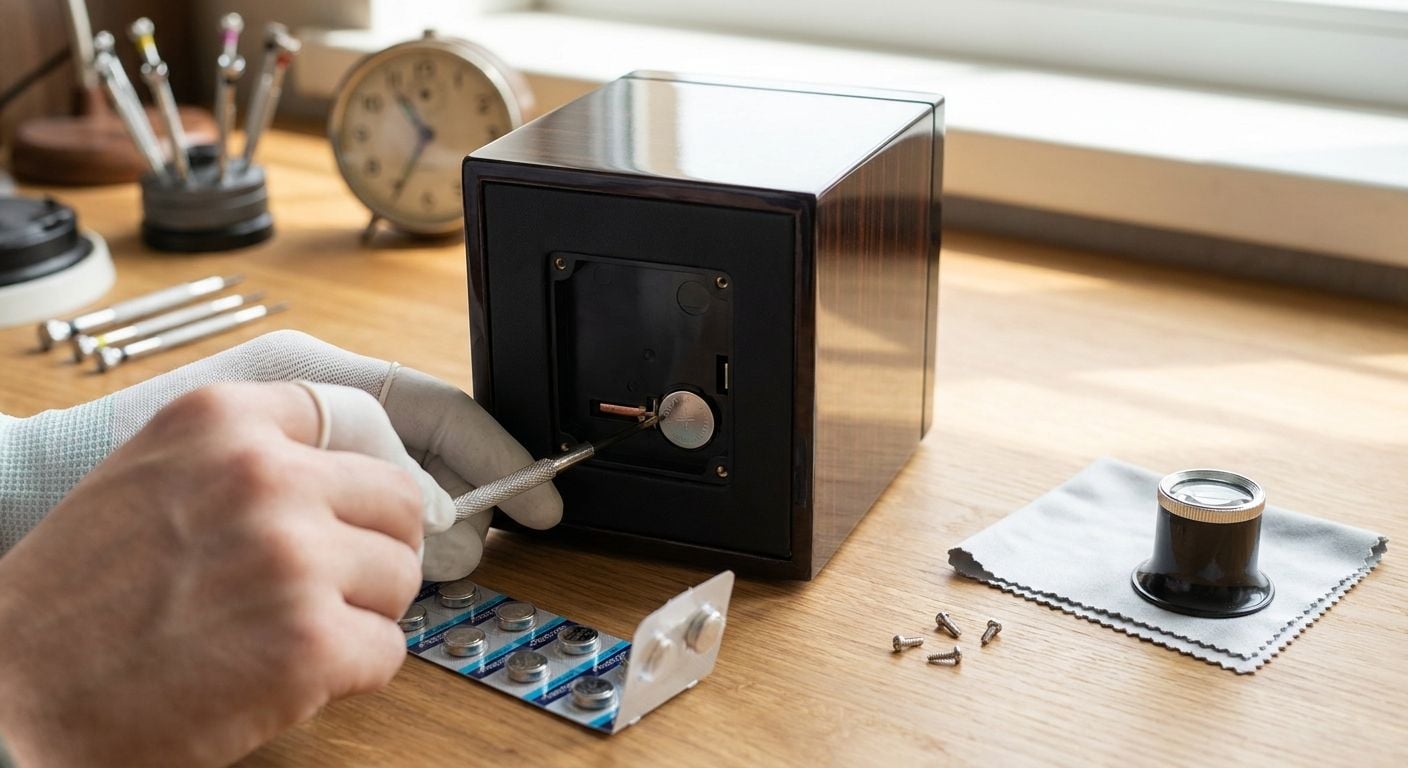
Most watch winders that run on batteries use four C-cell or D-cell batteries housed in a compartment on the base or back panel, and you replace them by powering down the unit, swapping the old cells for fresh ones with matching polarity, then restarting the rotation program. The catch: pulling battery power mid-cycle on a hybrid AC/battery unit often resets your turns-per-day and direction settings, so you'll need to reprogram the winder after every swap, not just reload it.
- Most battery-powered watch winders take 4 C-cell or D-cell batteries in a compartment on the base or back.
- Swapping batteries usually wipes the TPD and direction program — plan to reset it every time.
- A slowing or stuttering rotor is the clearest sign batteries need replacing, not a dead stop.
- Plug-in winders like Enigwatch’s run on continuous AC power and never need battery replacement.
- Rechargeable NiMH cells work in most units if the voltage matches the manufacturer’s spec.
Why this matters
A watch winder that stalls mid-cycle isn't winding your automatic movement — it's just sitting there while the mainspring runs down. If you rely on battery power because your winder lives in a closet without an outlet or you travel with a portable unit, dead batteries are the single most common reason a "broken" winder turns out to be fine. Before you assume a motor failure, check the battery compartment first — it's the cheapest fix in the entire troubleshooting list. Enigwatch's voltage guide covers the AC side of this question for winders that run off a mains adapter instead.
How to replace watch winder batteries
The process is the same across nearly every brand that ships with a battery option — only the compartment location and battery count shift model to model.
- Power down the unit. If your winder has both a battery compartment and an AC adapter, unplug the adapter first so the unit doesn't try to run on two power sources at once.
- Find the battery compartment. It's typically a sliding or screw-down panel on the base, the back, or the underside of a portable single winder.
- Note the polarity before removing anything. Most compartments print a diagram inside the panel — take a photo with your phone if it's not obvious.
- Swap in fresh batteries. Match the size printed inside the compartment (commonly 4x C or D cells) and load them in the same orientation as the ones you removed.
- Close the compartment and restore power. If the unit uses an AC adapter as primary power, plug that back in now.
- Reprogram the rotation settings. Set turns-per-day (TPD) and direction to match your watch's movement specs — most units revert to a factory default after a full power interruption.
- Watch the first full cycle. Confirm the rotor turns smoothly and completes a full rotation before you walk away.
Battery-powered vs. AC-powered winders
| Power type | Battery replacement needed | When it fails | Best for |
|---|---|---|---|
| Battery-only winder | Yes, on a recurring basis | Rotor slows or stops as cells drain | Travel cases, closets without outlets |
| Hybrid AC/battery winder | Only when running off battery mode | Program resets after a swap | Backup power during outages |
| Plug-in AC winder | Never | Only on a genuine power outage | Permanent installations, cabinets |
A battery-only unit is convenient for placement flexibility, but it asks you to run maintenance on a recurring basis that a plug-in winder never requires. A hybrid unit gives you the best of both, provided you're willing to reprogram it after every battery change.
Why watch winder battery life varies
Battery drain isn't consistent across brands, models, or how you use the winder. A handful of factors drive most of the variation:
- Turns-per-day setting. A winder set to 800+ TPD for a Rolex-style movement burns through cells faster than one set to 300 TPD for a simpler caliber.
- Battery chemistry. Alkaline cells degrade faster under continuous load than lithium or quality NiMH rechargeables.
- Number of rotors sharing power. A 6-slot or 12-slot unit running multiple motors off one battery bank drains faster than a single winder.
- Rest cycle programming. Winders with built-in rest periods (winding for a few hours, then pausing) conserve battery life compared to units that spin continuously.
- Ambient temperature. Cold storage rooms or unheated closets reduce battery output, especially with alkaline cells.
- Mixing old and new batteries. Combining partially drained cells with fresh ones in the same compartment shortens the life of the new batteries and can cause uneven motor torque.
“Check the battery compartment before you assume the motor failed — it’s the cheapest fix on the list.”
Owners running plug-in luxury units skip this entire maintenance category. Enigwatch's watch winders and winder cabinets draw continuous AC power, so there's no compartment to open and no program to reset after a battery swap — the rotation settings stay put unless the power itself cuts out. If you're deciding between a portable battery unit and a permanent AC-powered piece for a home installation, that's the trade-off worth weighing before you buy.
Compare winders before you buy
See plug-in models that skip battery maintenance entirely.
How do I know when watch winder batteries need replacing?
A slowing, stuttering, or intermittently stopping rotor is the clearest sign your batteries need replacing, not a sudden dead stop. Watch for a rotor that hesitates mid-turn or a winder that starts a cycle but doesn't complete it — that's voltage sag from depleted cells, not a motor problem. If the unit has an LED indicator, a dim or flickering light usually confirms it.
Can I use rechargeable batteries in a watch winder?
Yes, rechargeable NiMH batteries work in most watch winders as long as the voltage output matches what the manufacturer specifies for standard alkaline cells. Check the manual before switching, since a mismatch in voltage can under-power the motor or, in rare cases, strain it. Rechargeables cut down on the recurring cost of replacement but do require their own charging routine.
Do I need to reset the TPD after changing batteries?
Most battery-only and hybrid winders reset turns-per-day and direction settings after a full power interruption, so yes, plan on reprogramming after every swap. Some higher-end units retain settings in onboard memory even when the batteries are removed, but that behavior varies by model — check your manual rather than assuming your unit is the exception. If you calibrate for a specific movement, the calibration guide walks through resetting TPD for a new watch.
FAQ
How often do watch winder batteries need replacing?
Frequency depends on TPD setting, battery chemistry, and how many rotors share the same battery bank, so there’s no fixed interval — watch for a slowing or stuttering rotor as your cue rather than a calendar date.
What size batteries do most watch winders use?
Most battery-powered watch winders use four C-cell or D-cell batteries, though the exact size is always printed inside the compartment panel — check there before buying replacements.
Is it better to buy a plug-in watch winder instead of a battery one?
A plug-in AC winder removes the recurring battery replacement task entirely and holds its program through normal use, making it the lower-maintenance choice for a permanent home installation in 2026.
Why did my watch winder reset after I changed the batteries?
Most units lose their TPD and direction memory when power cuts out completely during a battery swap, so reprogramming after every change is normal, not a defect.
Can old batteries damage a watch winder motor?
Leaking alkaline batteries can corrode the compartment contacts and interrupt power delivery to the motor, so replacing cells before they leak protects the unit long term.
Do watch winder cabinets need battery replacement?
Watch winder cabinets typically run on continuous AC power rather than batteries, so there’s no compartment to maintain — confirm the power source on the specific cabinet you’re considering.
What happens to my watch if the winder batteries die overnight?
The rotor simply stops turning and your automatic watch continues running down on its stored power reserve until you notice and replace the batteries or plug in an AC adapter.
One last thing
The detail most owners miss in 2026 isn't the battery size — it's the polarity diagram printed inside the compartment. Loading cells backward won't just fail to power the unit; on some hybrid winders it can trip an internal fuse that requires a service visit to reset. Snap a photo of the compartment before you pull the old batteries, and you'll never have to guess which way the fresh ones go back in.
Related guides
- How to reset a watch winder after power loss
- How to clean a watch winder rotor and motor
- How to lubricate a watch winder mechanism
- Watch winder power outage: what happens to your watch
Protect Your Watch Collection
Designed for collectors who demand the best. Explore our premium watch winders and luxury safes.