
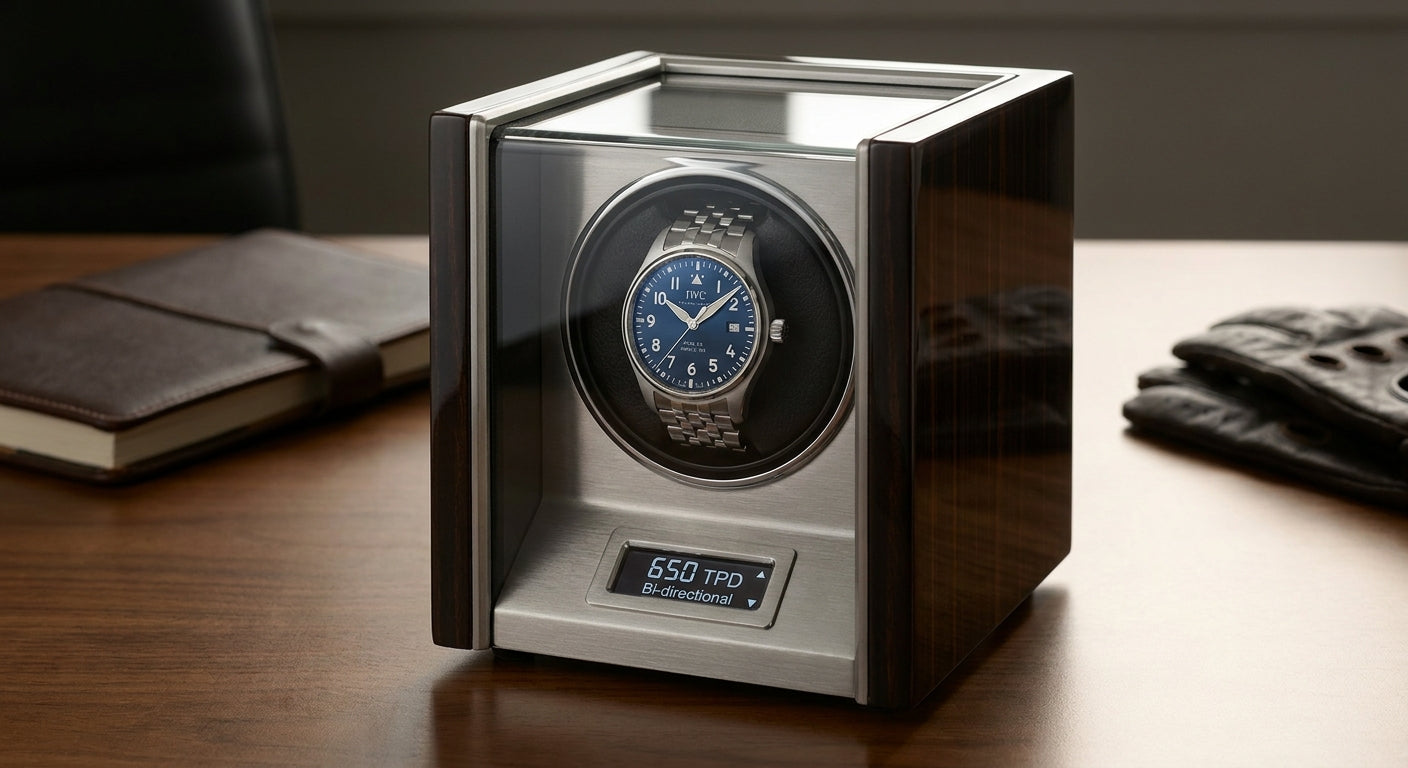
The IWC Pilot’s Watch Mark XX runs on the IWC 32111 calibre — a Sellita SW300-1 derivative with a 72-hour power reserve and a bidirectional rotor. Getting the winder settings right for this movement is not complicated, but getting them wrong means a watch that stops mid-flight plan or, worse, one that runs magnetized and fast because it never fully rests.
TL;DR: The IWC Pilot’s Watch Mark XX needs a watch winder set to 650–800 TPD, bidirectional rotation, with rest intervals of 6–8 hours per day. The IWC 32111 calibre is not power-hungry, but it rewards consistent winding over aggressive TPD counts. For collectors who rotate several pilot watches, the Impresario Series 6 is the most practical fit in 2026.
Why the Mark XX’s Movement Changes Everything
The IWC 32111 is a modified Sellita SW300-1 with a 42-hour declared power reserve in some references and a 72-hour reserve in the Mark XX specifically. IWC upgraded the power reserve when they moved from the Mark XVIII to the Mark XX in 2022. That longer reserve means the watch tolerates short gaps in winding better than the older calibre — but it also means over-winding is genuinely easy if your winder runs all day without rest pauses.
The bidirectional rotor on this movement winds in both directions, which is essential to know. A unidirectional winder wastes roughly half of every rotation cycle. On a 650 TPD setting with bidirectional motion, the effective mechanical input is well-matched to what the 32111 needs to stay powered without placing stress on the mainspring.
Who This Guide Is For
You own an IWC Pilot’s Watch Mark XX — ref. IW328201, IW328202, IW328206, or a related variant — and you want a winder that keeps it ready without babysitting settings. You probably rotate between two or more pilot watches, or you have a broader collection that includes field watches and dress watches. You are not chasing the cheapest motor on the market; the Mark XX retails above $5,000 and the winder should reflect that.
What to Look for in a Watch Winder for the IWC Mark XX
TPD Range That Covers 650–800
The IWC 32111 performs well between 650 and 800 turns per day. Winders that only offer fixed programs at 1,000 or 1,200 TPD will over-wind the mainspring over time. You need a winder with programmable TPD — not just three preset modes — so you can dial in 650 or 750 specifically. In 2026, every serious winder in the $500-and-above tier offers this. Below that price, you are often stuck with generic presets.
Bidirectional Motor, Not a Marketing Label
Bidirectional on the spec sheet and bidirectional in practice are two different things. Some budget winders rotate clockwise for a fixed count, pause, then rotate counterclockwise — which is technically bidirectional but mechanically inefficient because the direction switches happen at the same point in every cycle. A quality motor alternates direction in genuine variable patterns. Japanese Mabuchi motors — the standard in Enigwatch units — achieve this consistently across the operating life of the winder.
Programmable Rest Intervals
The Mark XX’s 72-hour power reserve means the movement needs to rest. A winder running 24 hours continuously is not doing the watch any favors. Program 16–18 hours of rotation spread across the day, with 6–8 hours of rest. This matches how the watch behaves when worn — periods of motion interrupted by stillness at a desk or overnight. Winders without configurable rest intervals are not appropriate for a watch at this price point.
Motor Noise Under 10 dB
Pilot watch collectors tend to be detail-oriented. A winder that hums audibly in a bedroom or office becomes annoying within a week. Enigwatch units using Japanese Mabuchi motors operate at under 10 dB at one meter — quiet enough to run unnoticed beside a nightstand. If a winder does not list a noise specification, assume it is not quiet.
Case Diameter Clearance
The Mark XX measures 40mm across the case, which is not oversized, but the crown position and lug-to-lug length of 47.5mm matter for how the watch sits in the winder cushion. You want a winder rotor that accommodates watches up to 53mm lug-to-lug and adjusts for different case depths. A fixed cushion that does not adjust will torque the crown against the rotor wall over time.
Interior Material Quality
Alcantara and Nappa leather interiors grip the watch strap without scratching the bracelet. Bare plastic or cheap velvet interiors generate static and can abrade the clasp finish on the Mark XX’s stainless steel bracelet over months of daily cycling. This is a small detail that compounds across years of use.
Top Picks for the IWC Pilot’s Watch Mark XX in 2026
The Focused Single-Watch Option — Delta Series Single Watch Winder
The safe pick for a collector who owns one or two Mark XX variants and wants nothing more complicated. The Delta Series single watch winder accommodates the 40mm case comfortably, runs bidirectionally, and is programmable within the 650–800 TPD window. One concrete number: the rotor cushion adjusts from 36mm to 53mm lug-to-lug, which covers every current Mark XX reference. Verdict: Buy — the right tool for a focused collection.
The Multi-Watch Workhorse — Impresario Series 6
The practical pick for a collector rotating the Mark XX alongside a Portugieser, a Big Pilot, or a dress watch. Six independent motors mean each watch gets its own TPD and direction setting — the Mark XX at 750 TPD bidirectional, a Big Pilot (IWC calibre 51111) at 650 TPD clockwise, simultaneously. The Impresario Series 6 watch winder has a Japanese Mabuchi motor per slot, Alcantara interior, and runs quietly enough for a study or bedroom. Verdict: Buy — the strongest value at this capacity in 2026.
The Growing-Collection Choice — Impresario Series 12
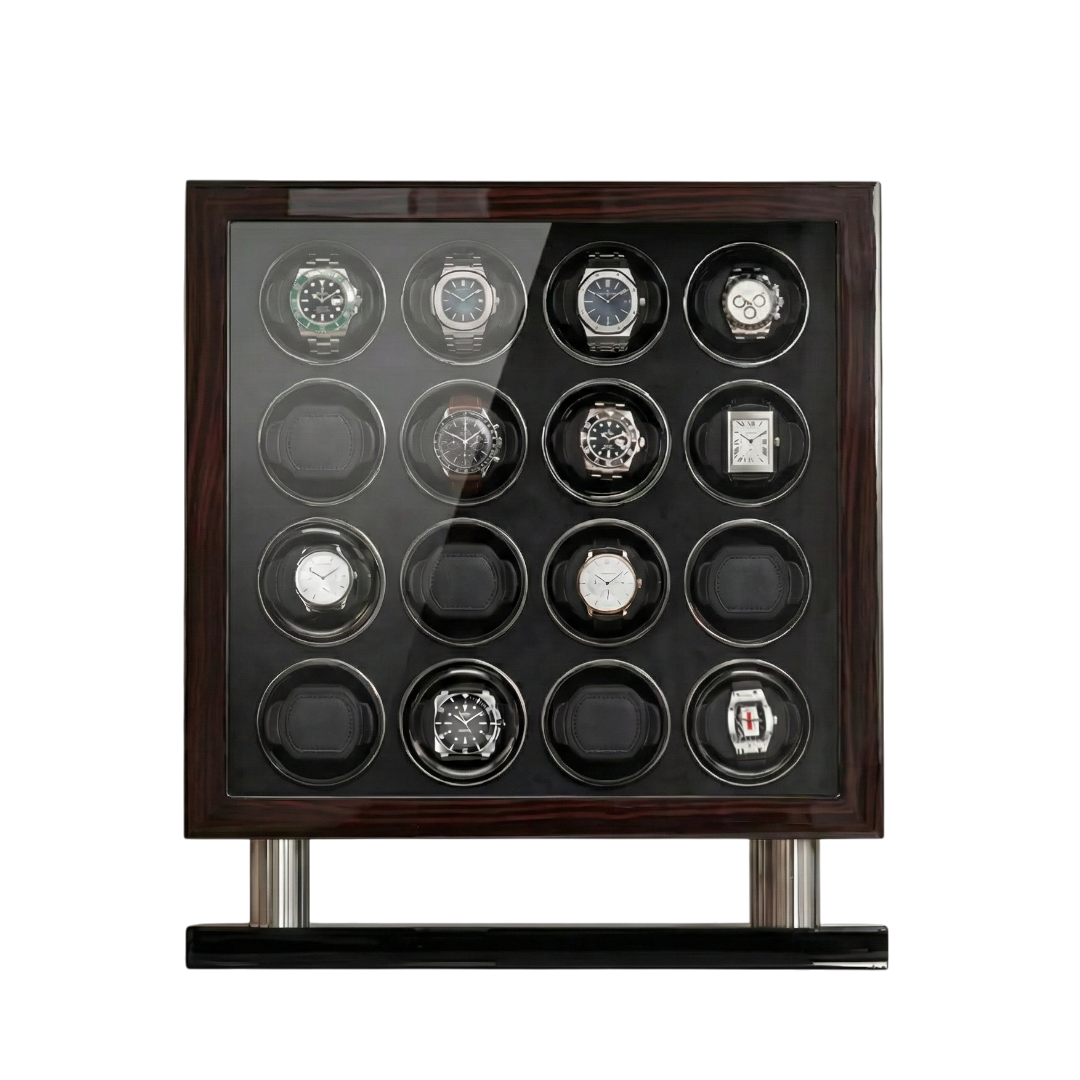
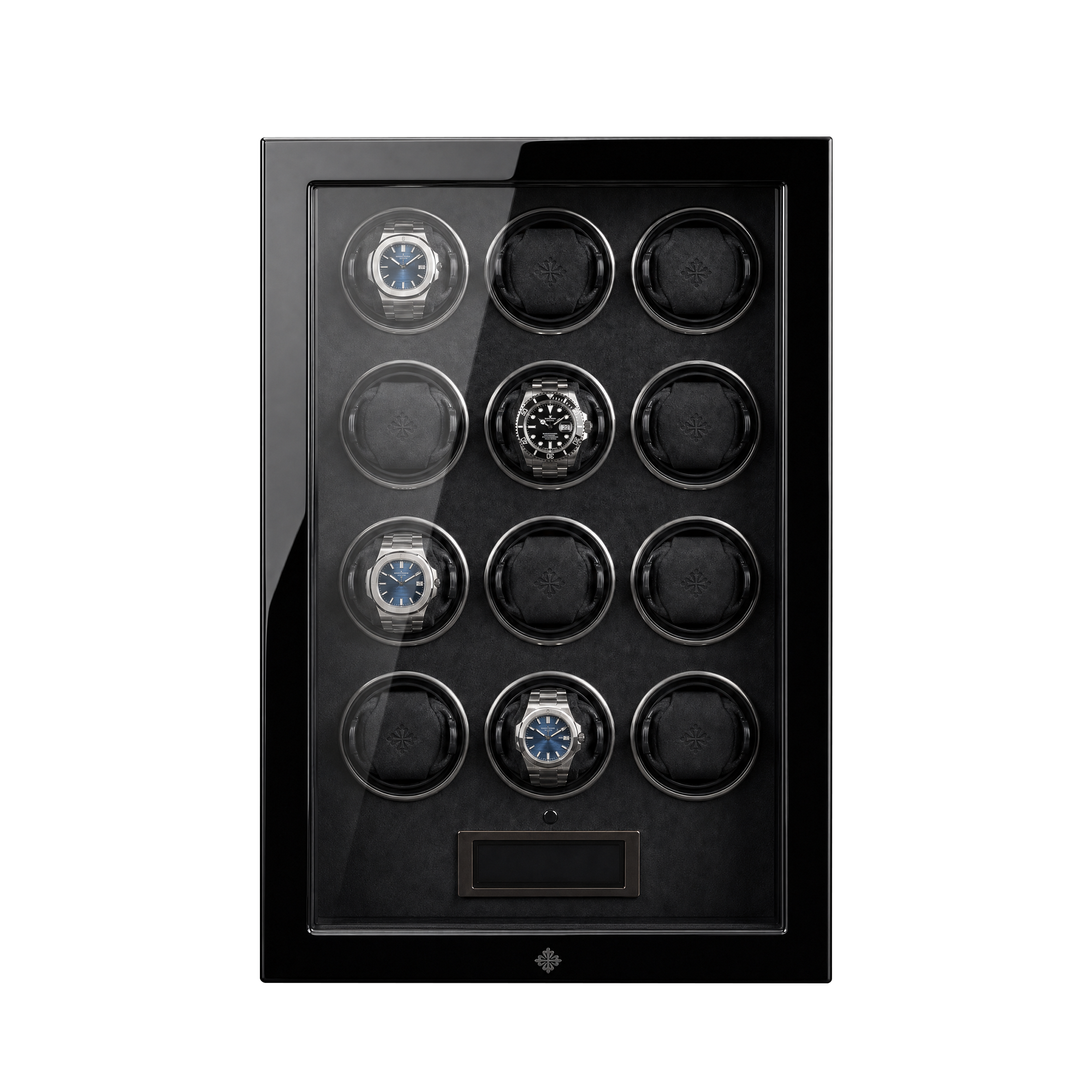
The forward-looking pick for a collector whose IWC rotation is already at four or five pieces and expanding. Twelve independent winding positions, each programmable individually, with the same motor standard and interior finish as the Series 6. The Impresario Series 12 watch winder eliminates the need to buy a second unit when the collection grows. Cost per slot is lower than buying two 6-slot units. Verdict: Buy — the correct long-term decision if you own more than five automatics.
The Display-First Option — Virtuoso Series 6
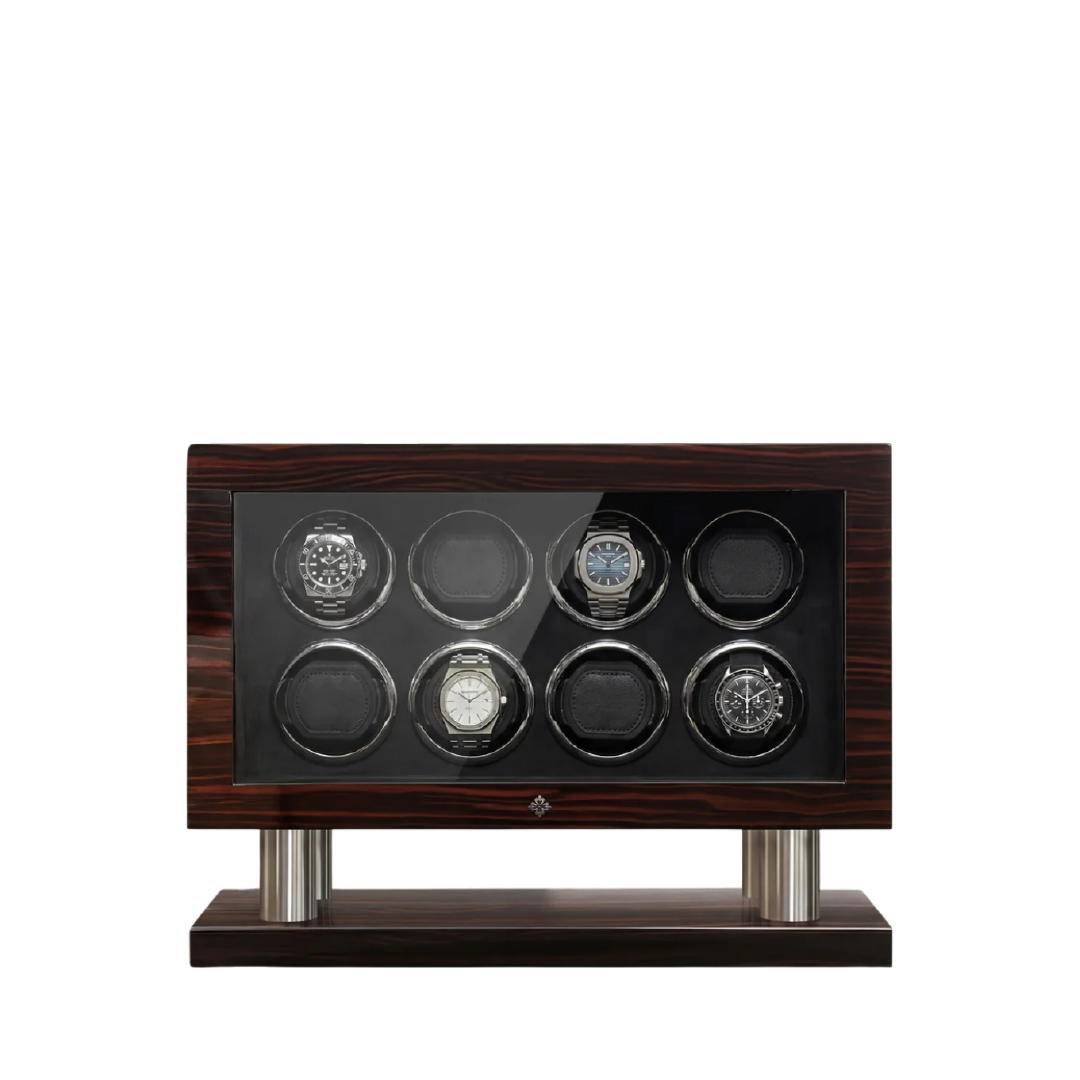
The aesthetic pick for collectors who want the winder visible in a study or display room. The Virtuoso Series 6 watch winder offers the same programmable motor standard and bidirectional operation with a cabinet design built to be seen. Settings for the Mark XX apply identically: 700 TPD, bidirectional, 18 hours on / 6 hours rest. Verdict: Consider — mechanically equivalent to the Impresario Series 6, but the price premium is for aesthetics, not function.
What to Avoid
- Fixed-program winders with only three TPD presets. If the winder offers “650 / 1,000 / 1,800” with no intermediate settings, the 650 setting is marginal for the Mark XX and the gap to the next preset is too large. Pass.
- Unidirectional winders marketed as “compatible” with IWC. The 32111 rotor is bidirectional. A unidirectional winder wastes half of each rotation cycle and may under-wind the movement over several days, requiring manual hand-winding to catch up.
- Winders without rest-cycle programming. Running the Mark XX’s mainspring at tension 24 hours a day is not neutral — it keeps the lubricants under constant load. A winder with no rest mode is not appropriate for a watch with a declared 72-hour power reserve.
Settings Comparison Table
| Winder | TPD Range | Direction | Rest Interval | Slots | Verdict |
|---|---|---|---|---|---|
| Delta Series Single | 100–1,950 | Bidirectional | Programmable | 1 | Buy |
| Impresario Series 6 | 100–1,950 | Bidirectional | Programmable | 6 | Buy |
| Impresario Series 12 | 100–1,950 | Bidirectional | Programmable | 12 | Buy |
| Virtuoso Series 6 | 100–1,950 | Bidirectional | Programmable | 6 | Consider |
Recommended Settings — IWC Pilot’s Watch Mark XX
| Parameter | Setting |
|---|---|
| TPD | 650–800 |
| Direction | Bidirectional |
| Daily rotation | 16–18 hours |
| Rest period | 6–8 hours |
| Cushion size | 36–53mm lug-to-lug |
FAQ
What TPD does the IWC Pilot’s Watch Mark XX need in a winder?
The Mark XX runs on the IWC 32111 calibre, which performs well at 650–800 TPD. Set your winder to 700 TPD as a default; the 72-hour power reserve means you have tolerance in either direction.
Should the winder rotate clockwise or counterclockwise for the Mark XX?
Bidirectional. The 32111 has a bidirectional rotor, so it winds in both directions of rotation. A unidirectional winder underutilizes the movement’s winding efficiency.
Can I use a single-direction winder with the IWC Mark XX?
Technically yes — the movement will wind — but you will need a higher TPD setting to compensate for the lost efficiency, which increases mainspring stress over time. Bidirectional is the correct choice.
Will a watch winder damage the IWC Mark XX’s movement?
Not if the settings are correct. The risk comes from running continuous rotation without rest intervals or using TPD counts above 1,000 on a movement that does not need them. At 700 TPD bidirectional with rest pauses, the movement experiences less stress than a day of active wear. See also: does a watch winder damage automatic watches.
How long can the IWC Pilot’s Watch Mark XX run without a winder?
The Mark XX has a 72-hour power reserve. Worn daily, it runs indefinitely. Left static, it stops within three days. If you rotate it out of regular wear, a winder set to 700 TPD bidirectional keeps it ready without manual hand-winding.
Is the IWC Pilot’s Watch Mark XX the same movement as the Mark XVIII?
No. The Mark XVIII used a 30110 calibre with a shorter power reserve. The Mark XX moved to the 32111, which IWC introduced in 2022 with a 72-hour power reserve. The winder settings differ — the 32111 is less power-hungry than the older calibre.
How many winder slots do I need for an IWC pilot watch collection?
If you own two to three pilot watches, the Impresario Series 6 gives you room to grow without excess. Four or more pieces — including a Big Pilot, a Portugieser, and a Mark XX — makes the Impresario Series 12 the more sensible choice per slot.
What noise level should a watch winder produce near a bedroom?
Under 10 dB at one meter is the threshold for genuinely unnoticeable operation. Enigwatch units with Japanese Mabuchi motors meet this. Anything that produces an audible hum at arm’s length is too loud for a bedroom or study.
One Last Thing
The IWC 32111 calibre is deliberately over-spec’d for the Mark XX’s case size — IWC built in 72 hours of reserve so the watch survives a long weekend without fuss. That same design intention means it is forgiving in a winder. You do not need to chase 800 TPD precisely. Set it to 700, run bidirectional with a 6-hour nightly rest, and the movement will not require manual correction for months of continuous winding. The engineering already did the hard work — the winder just needs to stay out of its way.
Related Guides
Protect Your Watch Collection
Designed for collectors who demand the best. Explore our premium watch winders and luxury safes.