Grand Seiko's mechanical calibers run at tolerances that rival any Swiss equivalent. The 9S85 hi-beat pulses at 36,000 vibrations per hour. The 9S64 holds 72 hours of reserve with timekeeping certified to within -3 to +5 seconds per day. Then there's Spring Drive, a hybrid that uses a mainspring for power but a quartz regulator for accuracy. All of it responds to consistent winding. Leave a Spring Drive 9R65 stopped for a week and the glide wheel stops too. A winder sized for Grand Seiko keeps both 9S mechanical and Spring Drive pieces running the way they were regulated to run.
What Makes Grand Seiko Different
Grand Seiko produces two fundamentally different movement families under one roof. Understanding which one is in your watch changes how you set up a winder.
The 9S series is conventional mechanical. Hi-beat and standard frequency variants, automatic winding, fully traditional architecture. These respond to winder settings the same way a Rolex or IWC would, with bidirectional rotation at a TPD matched to the caliber.
Spring Drive is Grand Seiko's proprietary technology. The rotor winds a mainspring like any automatic. The mainspring drives a glide wheel. The glide wheel's rotation is regulated electronically against a quartz oscillator through a Tri-Synchro Regulator. That sounds complex, but for winder purposes the key point is this: Spring Drive needs mainspring tension just like any mechanical watch. If the mainspring runs down, the watch stops. A winder keeps it running.
Then there's the 9F series. Quartz. No rotor, no mainspring. Don't put a 9F on a winder. It doesn't need one.
Grand Seiko TPD Requirements by Caliber
TPD stands for turns per day, the number of full rotations the winder completes in 24 hours. Grand Seiko's calibers sit in the moderate range, similar to other high-end automatics.
Caliber 9S64 (hand-wound automatic base, 72-hour reserve): 650 TPD, bidirectional. The workhorse Grand Seiko caliber in many current references.
Caliber 9S65 / 9S66 / 9S68 (standard-frequency automatics, 72-hour reserve): 650 TPD, bidirectional. Similar profile across the 9S6x family.
Caliber 9S85 / 9S86 (hi-beat, 36,000 VPH, 55-hour reserve): 800 TPD, bidirectional. Higher frequency means more energy consumption, and the shorter reserve responds to the upper TPD range.
Caliber 9R65 / 9R66 (Spring Drive automatic, 72-hour reserve): 650 TPD, bidirectional. Same TPD range as the 9S6x family. The rotor winds conventionally even though the regulation system is electronic.
Caliber 9R15 / 9R16 (Spring Drive Master Shop editions, 72-hour reserve): 650 TPD, bidirectional.
Caliber 9R96 (Spring Drive chronograph): 800 TPD, bidirectional. Chronograph movements consume more energy and benefit from the higher TPD setting.
For caliber references not listed here, the Enigwatch TPD reference covers Grand Seiko's range across current and recently discontinued movements.
What a Grand Seiko Winder Actually Needs
Four things matter more than the cushion colour or cabinet finish.
Numeric TPD input. The difference between 650 and 800 TPD matters for Grand Seiko. A winder with low/medium/high presets can't dial in the specific value your caliber wants. Look for units that let you enter TPD numerically.
Bidirectional rotation. Every current Grand Seiko automatic caliber, whether 9S or 9R, uses bidirectional winding. Single-direction winders cut efficiency and risk underwinding on the shorter-reserve hi-beat calibers.
Low-vibration motor. Japanese Mabuchi motors run quietly with minimal vibration transfer to the case. Grand Seiko's finishing deserves a winder that doesn't transmit motor hum into the movement. Anything audible from across the room is too loud.
Proper cushion fit. Most Grand Seiko references sit in the 37mm to 42mm range, which accommodates any properly sized winder cushion. Larger Sport Collection and Evolution 9 references run 40mm to 43mm, still well within standard cushion dimensions.
The Enigwatch Winders Built for Grand Seiko

Enigwatch winders ship with numeric TPD programming, bidirectional rotation, and Mabuchi motors operating below 10dB at normal distance. Here's how the lineup fits a Grand Seiko collection.
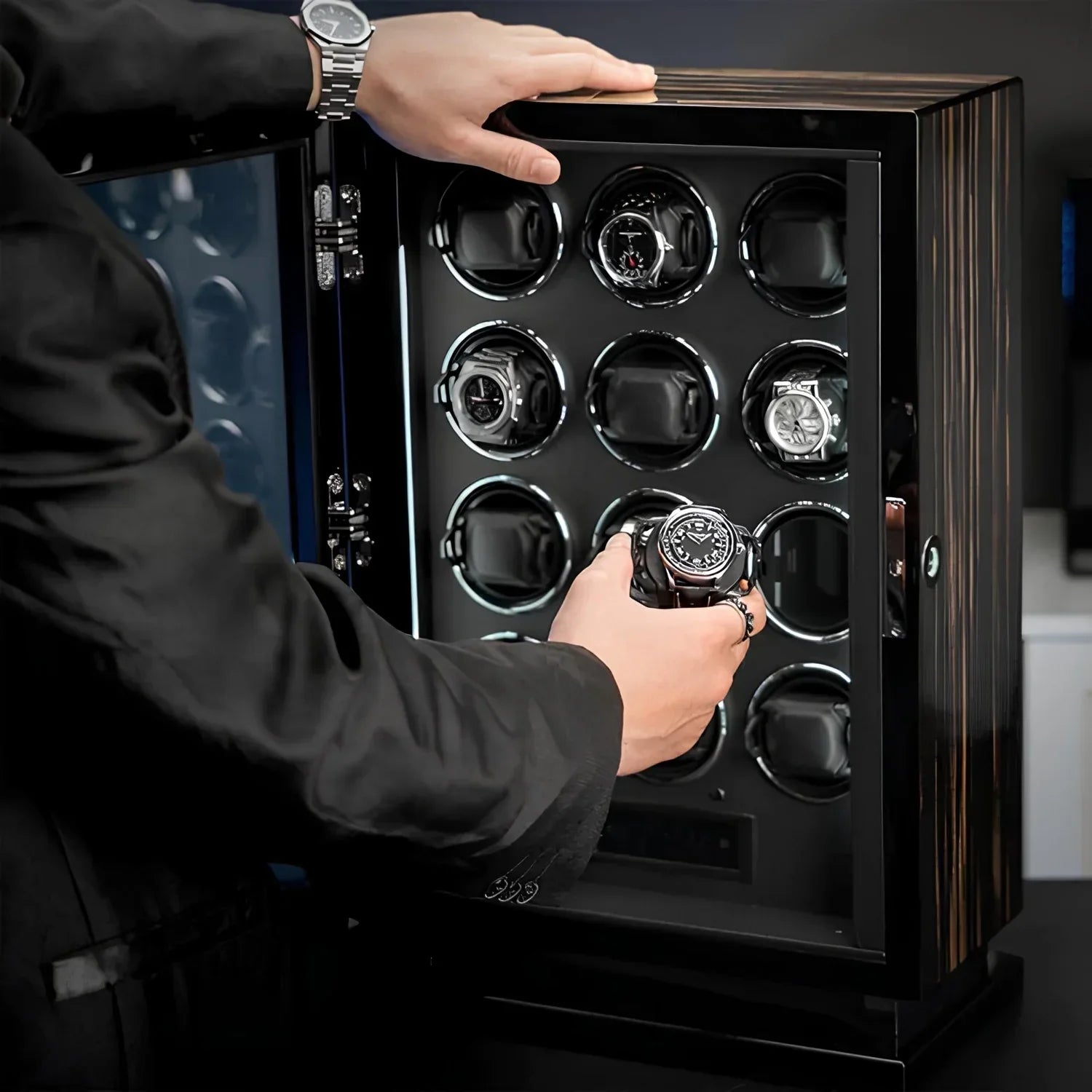
A single Grand Seiko piece: Start with an Impresario 2 for a dedicated home. Two rotors means you can add a second piece without buying again. See the Impresario range for single through twelve-rotor configurations.
A three-to-six-piece Grand Seiko collection: The Impresario 6 covers this cleanly. Per-rotor TPD programming lets your 9S85 hi-beat run at 800 TPD while your 9S64 runs at 650 TPD on the same unit.
Mixed collections across brands: Any Enigwatch multi-rotor unit handles a mixed collection with per-rotor settings. Your Grand Seiko at 650 TPD, a Rolex at 650 to 800 TPD, a Seiko at whatever the caliber specifies. All independent, all running continuously.
Interior surfaces are wooden or leather-lined, protecting the case and cushioning any residual vibration.
Setting Up Your Winder for a Grand Seiko
Setup is straightforward once you know the caliber.
Check the caseback. Grand Seiko engraves the caliber reference visibly. Cross-reference it against the TPD values above or the full table on the TPD reference page.
Set TPD to 650 for most 9S and 9R references. Go to 800 for hi-beat (9S85, 9S86) and Spring Drive chronograph (9R96). Set rotation to bidirectional.
Place the watch on the cushion. Crown orientation matters less for Grand Seiko than for ultra-thin references, but keeping the crown facing away from the rotor's point of closest approach is good practice.
Run the winder for 24 hours before checking accuracy. If your Spring Drive shows the characteristic sweeping seconds hand smoothly, the mainspring is at working tension.
Spring Drive on a Winder: What to Know
Collectors sometimes ask whether Spring Drive needs a winder. The short answer is yes, if the watch has an automatic variant. Manual-wind Spring Drive references don't have a rotor and don't benefit from a winder.
For automatic Spring Drive (9R65, 9R66, 9R15, 9R96), the rotor winds a mainspring that stores energy to drive the glide wheel. The Tri-Synchro Regulator handles accuracy using a quartz oscillator, but the mainspring still needs tension or the watch stops. A winder at 650 TPD bidirectional keeps it running indefinitely.
Spring Drive's sweeping seconds hand is only visible while the watch is running. Keeping it on a winder means you see that movement every time you pick it up.
Frequently Asked Questions
What TPD does a Grand Seiko need?
Most Grand Seiko calibers run at 650 TPD bidirectional. The 9S64, 9S65, 9S66, 9R65, and 9R66 all sit in this range. Hi-beat calibers (9S85, 9S86) and Spring Drive chronographs (9R96) benefit from 800 TPD. All modern Grand Seiko automatic calibers use bidirectional winding.
Does Spring Drive need a watch winder?
Automatic Spring Drive calibers do. The rotor winds a mainspring that drives the glide wheel, and the mainspring needs tension or the watch stops. Set an automatic Spring Drive (9R65, 9R66, 9R15, 9R96) to 650 or 800 TPD bidirectional. Manual-wind Spring Drive has no rotor and does not need a winder.
Can I put a 9F quartz Grand Seiko on a winder?
No. The 9F is a quartz movement with no mainspring or rotor. Putting it on a winder does nothing and may unnecessarily stress the case. Quartz Grand Seikos need secure storage, not winding infrastructure.
Do hi-beat Grand Seikos need a special winder?
They need a winder set to 800 TPD rather than 650 TPD. The higher beat rate of 36,000 VPH consumes more energy than standard-frequency movements, and the 55-hour reserve is shorter. Any Enigwatch winder with numeric TPD programming handles hi-beat calibers without issue.
Is it safe to leave a Grand Seiko on a winder long term?
Yes, on a correctly specified winder. The slip clutch prevents mainspring over-tensioning. Grand Seiko service intervals are comparable to Swiss equivalents at five to seven years. A low-vibration winder supports that timeline without adding mechanical wear.
What if my Grand Seiko runs slightly off on the winder?
Check TPD first. A 9S64 set to 500 TPD will underwind and show timekeeping drift. Also verify bidirectional rotation is enabled. If settings are correct and the watch still drifts beyond Grand Seiko's stated tolerance, the movement may need regulation. Grand Seiko's service center can adjust accuracy to specification.
Which Enigwatch winder fits a single Grand Seiko?
An Impresario 2 covers a single piece cleanly with room for a second watch. If your collection is growing or mixed with other brands, step up to the Impresario 6 for per-rotor programming across multiple references.
Can I run a Grand Seiko hi-beat and Spring Drive on the same winder?
Yes, on any Enigwatch multi-rotor unit. Set the hi-beat rotor to 800 TPD bidirectional and the Spring Drive rotor to 650 TPD bidirectional. Per-rotor programming means each watch gets exactly what its caliber needs with no compromise.
Build the Right Home for Your Grand Seiko
Grand Seiko's engineering earns infrastructure that matches it. Browse the Impresario range for single through twelve-rotor configurations.
If you're still working out the right TPD for your specific caliber, the TPD reference page lists Grand Seiko's full modern caliber breakdown.
Protect Your Watch Collection
Designed for collectors who demand the best. Explore our premium watch winders and luxury safes.