IWC's in-house calibers aren't like a generic ETA movement. The Pellaton winding system inside caliber 52010 uses a pawl-and-ratchet mechanism that extracts energy from rotor movement in both directions, and it needs consistent motion to stay topped up. A Big Pilot caliber 52110 has a 7-day power reserve, which sounds generous until you rotate three pieces through your collection. The one you wore last week is dead by the time you reach for it again. A winder sized for IWC keeps your Portugieser, Pilot, and Portofino references running at the tension their movements were engineered for.
What Makes IWC Different from Other Brands
IWC's engineering philosophy is utilitarian. Movements are built to run, be serviced, and keep running for decades. That shows up in how they respond to winder settings.
The Pellaton automatic winding system is the signature. Unlike a conventional rotor that drives a gear train in one direction, the Pellaton uses two pawls that engage the winding wheel regardless of rotor direction. Both directions contribute to winding. That means bidirectional rotation on your winder isn't optional for an IWC. A single-direction winder running on a Pellaton caliber will keep it wound, but inefficiently, and it'll struggle with longer power reserves.
IWC also builds some of the longest power reserves in the industry. Caliber 52010 holds 7 days. Caliber 59210 holds 8 days. These long reserves forgive occasional stops, but they also mean a properly specified winder barely works to keep them running. TPD requirements are moderate, not aggressive.
IWC TPD Requirements by Caliber
TPD stands for turns per day. It's the number of full rotations a winder completes over 24 hours to maintain mainspring tension. Every IWC caliber has a recommended TPD range. Underwinding lets the watch stop. Overwinding doesn't damage the movement (thanks to the slip clutch) but adds unnecessary motor hours.
Here's what IWC's modern calibers need:
Caliber 52010 / 52110 (Portugieser, Big Pilot 7-day): 650 TPD, bidirectional. The Pellaton system is efficient enough that a moderate TPD keeps the 7-day reserve fully wound.
Caliber 59210 (Portofino Hand-Wound 8 Days, automatic variants): 650 TPD, bidirectional. Similar profile to the 52-series with a longer reserve.
Caliber 82000 / 82100 (Pilot Mark XX, newer Portofino automatics): 650 to 800 TPD, bidirectional. A more compact in-house movement introduced in 2022, built around a 60-hour reserve and slightly higher torque demand.
Caliber 69000 series (IWC chronographs): 800 TPD, bidirectional. Chronograph movements run at higher energy consumption and benefit from the upper end of IWC's TPD range.
Caliber 51000 series (older Portugieser Automatic, still in circulation): 650 TPD, bidirectional. Same Pellaton architecture as the 52-series predecessors.
For older IWC references and less common calibers, the Enigwatch TPD reference covers the full range including vintage JLC-based and ETA-based movements used before IWC's in-house transition.
What an IWC Winder Actually Needs
Most winders are built for generic automatics. For IWC's calibers, you want a few specific things.
Programmable bidirectional rotation. The Pellaton system wants both directions. Fixed clockwise-only or counterclockwise-only winders cut winding efficiency roughly in half and will underperform on a 7-day reserve.
Precise TPD control. 650 to 800 TPD covers most of IWC's lineup. A winder with numeric TPD input lets you dial in exactly what the caliber needs. Generic low/medium/high presets are imprecise and force you to guess.
Quality motor. Japanese Mabuchi motors operate quietly with minimal vibration transfer. Cheap brushed motors that rattle at low RPM transfer that vibration straight into the movement. Not what you want running against an IWC's regulating organ.
Cushion fit for larger cases. The Big Pilot is 46mm. The Portugieser is typically 40.4mm to 44.2mm depending on reference. Your winder's cushions need to hold a larger case firmly without pressure on the crown. Undersized cushions that let the watch shift during rotation are a common problem in budget winders.
Enclosed housing. Humidity cycling affects movement lubricants over years. An enclosed or near-enclosed winder is better for long-term storage than an open display unit. Your IWC was built to run for 30 years between services. The environment around it should support that timeline.
The Enigwatch Winders Built for IWC

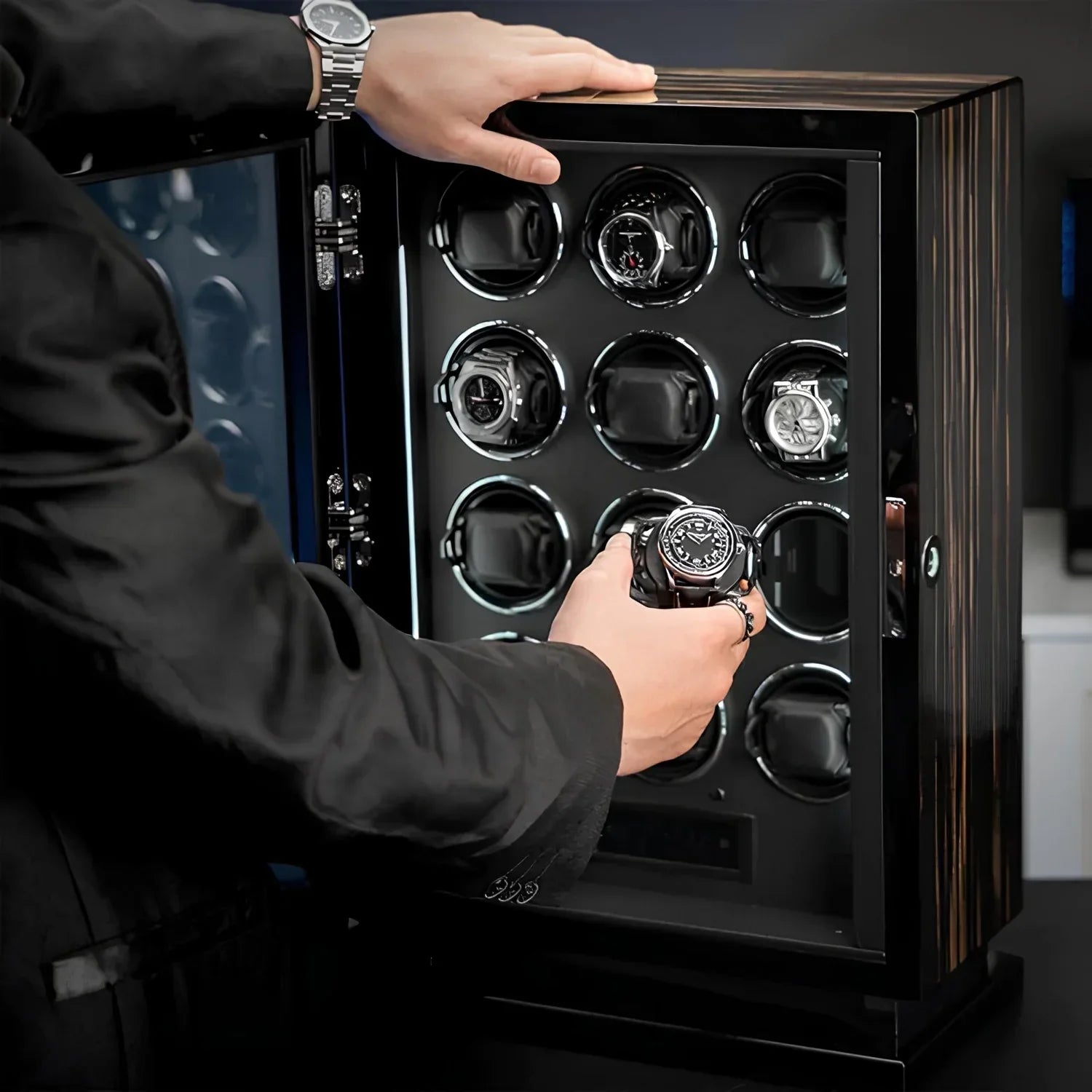
Enigwatch's standard winders ship with programmable TPD (numeric input, not presets), bidirectional rotation control, and Mabuchi motors rated below 10dB at operating distance. Here's how the lineup fits an IWC collection.
A single Pilot or Portugieser: A Virtuoso 2 covers it cleanly. Two rotors means you've got room to add a second piece without buying again. See the full Virtuoso range for single and dual configurations.
A three-to-six-piece IWC collection: The Impresario 6 is the right call. Six individually programmable rotors mean your Big Pilot at 650 TPD and your chronograph at 800 TPD each get the exact settings they need. No compromise on either.
Mixed collections beyond six watches: Yachtline 8 or Yachtline 16 scales up without changing motor quality or programming depth. Everything runs at its specified TPD simultaneously. You open the unit and every piece is fully wound.
Interior surfaces on all Enigwatch winders are either wooden or leather-lined, cushioning against vibration and protecting case finishes. A Big Pilot's brushed steel finish won't pick up micro-scratches from polyester lining.
Setting Up Your Winder for an IWC
Setup is quick once the unit arrives.
Check your caseback or original papers to identify the caliber. IWC typically engraves the caliber reference on the inside or rear of the case.
Set TPD to 650 for most references. Go to 800 for chronographs (69000 series) or newer Pilot Mark XX calibers (82000 series). Set rotation to bidirectional.
Place the watch on the cushion, crown facing away from the rotation axis if the winder design allows it. That reduces stress on the winding stem during rotation cycles.
Let the winder run for 24 hours, then check timekeeping accuracy against a reliable reference. A Big Pilot that was partially wound when placed may show a slight gain in the first day as the mainspring reaches full tension. After that, you should see timekeeping within IWC's stated tolerance.
Matching Rotor Count to Your Collection
One rotor per watch you want running at all times.
For IWC specifically, this is more forgiving than brands with complex calendar work. An IWC that stops just needs winding and time setting. You don't lose an hour resetting complications. So rotating pieces through fewer rotors on a weekly schedule is workable if space or budget is tight.
That said, most collectors who invest in a proper winder want everything running continuously. If you own four IWCs, buy a four-rotor (or six-rotor) winder and run them all. It costs less than under-specifying and needing to upgrade later.
If your collection is mixed across brands, see our broader guidance on winding multiple brands on one unit. An IWC at 650 TPD and a Rolex at 650 to 800 TPD both sit comfortably on the same multi-rotor Enigwatch unit.
Frequently Asked Questions
What TPD does an IWC watch need?
Most modern IWC calibers need 650 TPD with bidirectional rotation. Calibers 52010, 52110, 59210, and 51000-series all run at 650 TPD. Newer 82000-series and 69000-series chronograph movements benefit from 800 TPD. Every IWC caliber requires bidirectional rotation because of the Pellaton winding system.
Does the Pellaton winding system need a special winder?
It needs a winder that rotates in both directions. The Pellaton system uses two pawls that engage the winding wheel whether the rotor turns clockwise or counterclockwise. A single-direction winder wastes half the winding input and will struggle to keep a 7-day reserve topped up.
Can I use a winder with my Big Pilot 46mm?
Yes, provided the cushion holds a 46mm case firmly. Enigwatch cushions are sized to accommodate larger cases without pressure on the crown. The Impresario and Virtuoso ranges both handle Big Pilot references without issue. Verify cushion compatibility before buying if the winder spec doesn't list maximum case diameter.
Is it safe to leave an IWC on a winder long term?
Yes, on a winder with the correct TPD and a low-vibration motor. Modern automatic movements use a slip clutch that prevents the mainspring from over-tensioning, so overwinding isn't a risk. The movement runs at optimal tension and avoids the lubricant settling that happens when an automatic sits stopped for weeks.
How long does an IWC run before it stops?
Depends on the caliber. Caliber 52010 and 52110 hold 7 days at full wind. Caliber 59210 holds 8 days. Newer 82000-series calibers hold 60 hours. Older or simpler calibers may hold 42 to 46 hours. All of these are comfortable rotation intervals, but none is long enough to skip winding infrastructure if you rotate three or more pieces.
Does an IWC chronograph need a different winder setting?
Yes. Chronograph movements in the 69000 series run at higher energy consumption than time-only or simple date calibers. Set these to 800 TPD bidirectional rather than the 650 TPD used for standard IWC movements. The chronograph complication won't run accurately if the mainspring tension drops.
Which Enigwatch winder fits a single IWC Big Pilot?
A Virtuoso 2 covers a single Big Pilot cleanly with room for a second watch. If you plan to add IWC or other brands within the next year, step up to the Impresario 6 to avoid buying a second unit. Both options accommodate the Big Pilot's 46mm case diameter without fit issues.
Can an Enigwatch winder handle an IWC and a Rolex simultaneously?
Yes, on any multi-rotor Enigwatch unit with per-rotor programming. Set one rotor to 650 TPD bidirectional for the IWC and another rotor to 650 or 800 TPD for the Rolex. Each rotor runs its own program. There's no compromise between the two watches.
Build the Right Home for Your IWC
Your IWC was built to run continuously for decades with routine service. The winder around it should be matched to that expectation. Start with the Virtuoso Series for single and paired pieces, or go to the Impresario 6 if your collection is already past two or three references.
If you're still working out the right TPD for your specific caliber, the TPD reference page lists every IWC caliber across current and discontinued lines.
Protect Your Watch Collection
Designed for collectors who demand the best. Explore our premium watch winders and luxury safes.